Showing posts with label award show. Show all posts
Showing posts with label award show. Show all posts
Monday, February 23, 2015

Monday, January 26, 2015
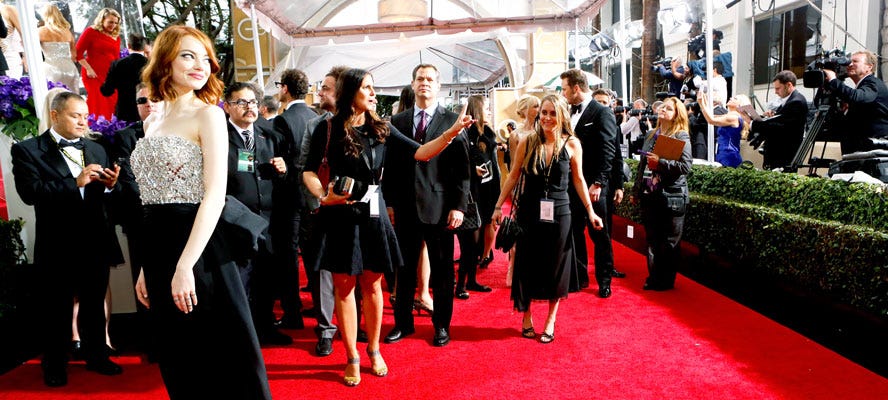
Eight facts about award shows from attendees
 |
| Trae Patton/Getty Images/NBC |
Fact 1: The red carpet is packed early. Everyone except for the nominees is dressed and in place about 90 minutes before any actors arrive. This year, the security was extra tight, so I totaled about four and a half hours in those heels on our Access Hollywood stage.
Fact 2: Arrival times for actors are not random. This is a well-oiled machine! Publicists usually decide on an arrival moment — the bigger the star, the later they walk up. George and Amal Clooney caused the biggest commotion when they walked the carpet at their first-ever awards ceremony together, right before the show started.
Fact 3: Most awards ceremonies, including the Oscars, are dry, meaning that there are no snacks and certainly no bubbles while you watch. But, the Golden Globes are different. While everyone takes their seats, dinner is served, and once the live show begins, chocolates and Champagne keep circulating around the room. So, the heckling, laughing, and bustle in the room are real; people are partying.
Fact 4: The Golden Globe statues themselves are lined up neatly on a little table, by the side of the stage. Last year, I sat a mere meter away and was kind of astounded at how unguarded they are.
Fact 5: During the commercial breaks, people mingle like crazy. A man on a loudspeaker has to politely encourage everyone to please take their seats, but by the end of the show, it’s like a little party in there. My all-time favorite moment was a couple of years ago when Adele won for her Skyfall track. She had her high heels in one hand, her statue in the other, and came up to me asking if I’d help her find her way back to her table. She ended up tiptoeing across the stage in her tights while the show came back on air; the cameras missed her by a second.
Fact 6: The best way to see all the action is by being a guest at the Hilton. Book a room! Unlike any other awards show, the Golden Globes awards ceremony and plethora of after-parties are all held under one roof: the Beverly Hilton Hotel. This year, I caught everyone from Melissa McCarthy to Diane Kruger to Adam Levine to Lorde just milling around in the lobby.
Fact 7: In fact, everyone has to line up for the parties, even the stars. This year, I queued up behind Maggie Q and Dylan McDermott.
Fact 8: For me, and a whole lot of other people in Hollywood, this is the night of no sleep. I behaved and left the party by midnight, but I had to be up at 3 a.m. to host a style segment on The Today Show. Then, it was straight to Access Hollywood to round up the night’s fashion hits and misses. And now, finally, a nap.
Monday, January 12, 2015
Sunday, January 4, 2015
Monday, April 14, 2014
Monday, January 13, 2014
Fact-checking five Oscar contenders
Awards season kicks into high gear this weekend, with the Golden Globes set to crown winners that will probably go on to score more than a few Oscars in March. As always, the list of nominees is packed with films that claim to be based in reality — but a closer look reveals that they may not even resemble the truth.
If you missed it, we already fact-checked Saving Mr. Banks, 12 Years a Slave, The Butler, Captain Phillips, Philomena, and Mandela: Long Walk to Freedom. Check it out here.
And now, let's fact check five more of this year's contenders:
1. American Hustle
 David O. Russell's star-studded period caper is based on the FBI's ABSCAM sting in the late '70s, which began as a simple investigation into stolen property but wound up implicating a number of corrupt public officials, including several members of Congress. In the film, Christian Bale stars as FBI informant Irving Rosenfeld — a character based on the real-life swindler Melvin Weinberg, who cooked up the idea of using agents dressed as Arab Sheikhs to lure potentially corrupt politicians into illegal deals.
American Hustle's title card concedes that only "some of these things actually happened," and mostly focuses on the characters surrounding the sting. But the film does leave out some of the key ramifications of ABSCAM, as Evan Hughes writes for Slate: "Abscam had some interesting postscripts that don't get aired in the movie. A debate that became central to the trial outlasted the case: Had the targets been entrapped? Didn't Weinberg put words in Senator Williams's mouth on that one tape? Apart from trying to impeach Weinberg's character, crying entrapment was just about the only defense that anyone could muster given the hard evidence. The Justice Department ended up overhauling the rules for undercover work to clarify what constitutes fair play."
A few other facts were changed for the film, such as the depiction of Camden Mayor Angelo Errichetti (who is rechristened Carmine Polito and played by Jeremy Renner in American Hustle). In real life, Errichetti was the big link between the slew of politicians eventually caught up in the sting and Weinberg and the FBI, who orchestrated it. As Jimmy So writes for The Daily Beast: "Christian Bale's Irving Rosenfeld liked Polito so much that he engineered a scheme to blackmail the FBI into giving Polito a reduced sentence. That's completely made up, although Weinberg did like Errichetti very much, not because he was a good man but because he was the biggest crook of them all. 'He's a likeable guy… he didn't beat around the bush,' Weinberg told 60 Minutes. 'He wanted to make money.'"
In addition, as So points out, American Hustle's FBI could only find a Mexican-American to pose as the Arab Sheikh. In real life, they started out with an agent who wasn't Mexican but didn't speak any Arabic, though they later managed to find a Lebanese-American to play the role.
2. The Wolf of Wall Street
 Leonardo DiCaprio stars as famed Wall Street con man Jordan Belfort in Martin Scorsese's hedonistic look at the excesses of '80s and '90s finance culture. The Wolf of Wall Street has become somewhat controversial for its unapologetic (and non-stop) depictions of sex and drug use — so much so that DiCaprio and Scorsese themselves have had to defend the film. The movie is based on a memoir of the same name by Belfort, whose brokerage firm Stratton Oakmont defrauded investors, leading to Belfort's 1998 indictment for money laundering and securities fraud. As Eliana Dockterman points out at TIME, the fact that the film is based on Belfort's own memoir is problematic to begin with: "After all, Belfort was a scam artist — he made a living by lying. Scorsese, knowing this, portrays Belfort (Leonardo DiCaprio) as an unreliable narrator in the film."
The focus on Belfort is also, perhaps, why the film skipped over any depiction of his victims. Joel M. Cohen, a former assistant United States Attorney who prosecuted Belfort, writes for The New York Times that victims "don't figure in the Belfort books, though thousands have not been recompensed. Similarly, remorse is merely a convenient word for Mr. Belfort, sandwiched between stories of drug-addled fraud and nasty put-downs of those closest to him….The filmmakers have said that they didn't want to depict Stratton's victims because it would detract from their focus on the brutality of the wrongdoers. The details that animate a successful criminal prosecution don't always make for compelling on-screen storytelling."
As for some of the seedier elements depicted in the film, such as dwarf-tossing: Though this came straight from Belfort's book, it's been disputed by Danny Porush, the co-founder and former president of Stratton Oakmont, Belfort's former firm. "The book... is a distant relative of the truth, and the film is a distant relative of the book," he told Asawin Suebsaeng of Mother Jones. Though Porush did admit to eating a goldfish, as his on-screen counterpart Jonah Hill does in the movie, Porush says "there was never a chimpanzee in the office... we never abused [or threw] the midgets in the office; we were friendly to them...There was no physical abuse."
3. Inside Llewyn Davis
 The unsuccessful Greenwich Village folk singer at the center of the Coen Brothers' Inside Llewyn Davis is a fictional character, but the film itself involves many composites of real people. Davis is loosely based on Dave Van Ronk, a folk singer living in the Village at the time, and Inside Dave Van Ronk was the album that inspired the film's title and the title character's own record. Though Van Ronk never made it big, he was integral to the scene, and, in fact, New York Times folk reporter Robert Shelton once labeled him "the musical mayor of MacDougal Street."
There are a lot of similarities between Oscar Isaac's Davis and the real Van Ronk. For instance, Van Ronk's past career as a merchant marine and his plan to give up music and return to the profession — a plan ultimately thwarted by his realization that he lost the necessary paperwork — were real. But Van Ronk did not start out in a duo, as Davis did, and was by many accounts not as much of a sad sack as Davis either. Van Ronk also has the distinction of being credited as a mentor to Bob Dylan, teaching him a thing or two about playing guitar, and even writing the version of "House of the Rising Sun" that Dylan later made famous (and possibly stole). "The character is not at all Dave, but the music is," Elijah Wald, who co-wrote Van Ronk's memoir, The Mayor of MacDougal Street, told the The New York Times.
As for the folk world in general, a number of people living the scene at the time have disputed the Coens' take on Greenwich during the era. "The performers reflect absolutely nobody I knew in the folk-music world," Van Ronk's first wife, Terri Thal, told Vulture. "The world that they live in is a depressing, unhappy place, and we lived in a fun, musically vibrant, intellectually interesting world. People were competitive only in the sense that they were trying to be heard — they weren't out to score above anybody else."
4. Rush
 Ron Howard adapted this story of the bitter rivalry between motor racers James Hunt, a Brit played by Chris Hemsworth, and Niki Lauda, an Austrian played by Daniel Brühl, and how their relationship evolved throughout their parallel careers.
But, as Alex von Tunzelmann writes for The Guardian, the main conceit of the film is largely embellished: "In fact, judging by Gerald Donaldson's biography of Hunt, their rivalry was quite friendly. Hunt won a Formula Two race against Lauda at Oulton Park in 1972; Donaldson notes that Lauda and another driver, Ronnie Peterson, congratulated him and 'were genuinely happy to see James finally get a share of the success they felt he deserved'. Hunt — who was not in the habit of sugar-coating anything he said to the press — said: 'I got on very well with Niki and always had done since we first met in Formula Three and gypsied around Europe together. We raced against each other but we also teamed up as mates, not just casual acquaintances.'"
Though this inaccuracy is not exactly confidence-inspiring, one major part of the movie is real: James Hunt's incessant partying. As Grantland's Patricia Lee writes, Hunt was something of a lothario. "Hunt was believed to have slept with more than 5,000 women, 'sometimes having sex minutes before a race.' Apparently 'Hunt's appetite for wine and women was legendary.' Exactly how legendary? Well, Hunt slept with 33 British Airways stewardesses and a number of Japanese fans during his two-week stay in Tokyo for the 1976 Japanese Grand Prix."
5. Dallas Buyer's Club
 Matthew McConaughey plays Ronald Woodroof, a Texas electrician who is diagnosed with AIDS and eventually sets up the titular drug ring that helped procure unauthorized AIDS drugs for those who couldn't afford AZT or had a negative reaction to it.
According to TIME, Woodroof did indeed smuggle the drugs across the border from Mexico, occasionally disguised as a doctor or a priest, and "even once filled a suitcase with dry ice when moving through customs in Japan to conceal drugs (after bribing a Japanese doctor for a shipment of drugs not-yet-approved in America)." The film is also accurate in its portrayal of Woodruff as an initially homophobic womanizer who remained in denial about his disease for some time, but who evolved as he came into contact with gay people through his work.
But other aspects of the film were purely fictional, including Woodruff's partnerships with Jared Leto's transgender character Rayon and Jennifer Garner's Dr. Eve Saks. As Aisha Harris writes forSlate: "[Co-writers Craig Borten and Melisa Wallack] interviewed a number of transgendered activists and doctors who faced similar struggles with access to drugs during the course of their writing, and they created composites of those people for the film...Rayon in particular was created as a character to give Ron a dramatic challenge to his prejudices while facing disease, Borten told me. The real Woodroof didn't have any particular Rayon in his life, but he was, in fact, deeply changed by his diagnosis and his subsequent work with the Dallas Buyers Club. The character arc, from bigotry to tolerance, does, Borten says, reflect Woodroof's own transformation from a homophobe to a compassionate advocate."
Source
If you missed it, we already fact-checked Saving Mr. Banks, 12 Years a Slave, The Butler, Captain Phillips, Philomena, and Mandela: Long Walk to Freedom. Check it out here.
And now, let's fact check five more of this year's contenders:
1. American Hustle
David O. Russell's star-studded period caper is based on the FBI's ABSCAM sting in the late '70s, which began as a simple investigation into stolen property but wound up implicating a number of corrupt public officials, including several members of Congress. In the film, Christian Bale stars as FBI informant Irving Rosenfeld — a character based on the real-life swindler Melvin Weinberg, who cooked up the idea of using agents dressed as Arab Sheikhs to lure potentially corrupt politicians into illegal deals.American Hustle's title card concedes that only "some of these things actually happened," and mostly focuses on the characters surrounding the sting. But the film does leave out some of the key ramifications of ABSCAM, as Evan Hughes writes for Slate: "Abscam had some interesting postscripts that don't get aired in the movie. A debate that became central to the trial outlasted the case: Had the targets been entrapped? Didn't Weinberg put words in Senator Williams's mouth on that one tape? Apart from trying to impeach Weinberg's character, crying entrapment was just about the only defense that anyone could muster given the hard evidence. The Justice Department ended up overhauling the rules for undercover work to clarify what constitutes fair play."
A few other facts were changed for the film, such as the depiction of Camden Mayor Angelo Errichetti (who is rechristened Carmine Polito and played by Jeremy Renner in American Hustle). In real life, Errichetti was the big link between the slew of politicians eventually caught up in the sting and Weinberg and the FBI, who orchestrated it. As Jimmy So writes for The Daily Beast: "Christian Bale's Irving Rosenfeld liked Polito so much that he engineered a scheme to blackmail the FBI into giving Polito a reduced sentence. That's completely made up, although Weinberg did like Errichetti very much, not because he was a good man but because he was the biggest crook of them all. 'He's a likeable guy… he didn't beat around the bush,' Weinberg told 60 Minutes. 'He wanted to make money.'"
In addition, as So points out, American Hustle's FBI could only find a Mexican-American to pose as the Arab Sheikh. In real life, they started out with an agent who wasn't Mexican but didn't speak any Arabic, though they later managed to find a Lebanese-American to play the role.
2. The Wolf of Wall Street
Leonardo DiCaprio stars as famed Wall Street con man Jordan Belfort in Martin Scorsese's hedonistic look at the excesses of '80s and '90s finance culture. The Wolf of Wall Street has become somewhat controversial for its unapologetic (and non-stop) depictions of sex and drug use — so much so that DiCaprio and Scorsese themselves have had to defend the film. The movie is based on a memoir of the same name by Belfort, whose brokerage firm Stratton Oakmont defrauded investors, leading to Belfort's 1998 indictment for money laundering and securities fraud. As Eliana Dockterman points out at TIME, the fact that the film is based on Belfort's own memoir is problematic to begin with: "After all, Belfort was a scam artist — he made a living by lying. Scorsese, knowing this, portrays Belfort (Leonardo DiCaprio) as an unreliable narrator in the film."The focus on Belfort is also, perhaps, why the film skipped over any depiction of his victims. Joel M. Cohen, a former assistant United States Attorney who prosecuted Belfort, writes for The New York Times that victims "don't figure in the Belfort books, though thousands have not been recompensed. Similarly, remorse is merely a convenient word for Mr. Belfort, sandwiched between stories of drug-addled fraud and nasty put-downs of those closest to him….The filmmakers have said that they didn't want to depict Stratton's victims because it would detract from their focus on the brutality of the wrongdoers. The details that animate a successful criminal prosecution don't always make for compelling on-screen storytelling."
As for some of the seedier elements depicted in the film, such as dwarf-tossing: Though this came straight from Belfort's book, it's been disputed by Danny Porush, the co-founder and former president of Stratton Oakmont, Belfort's former firm. "The book... is a distant relative of the truth, and the film is a distant relative of the book," he told Asawin Suebsaeng of Mother Jones. Though Porush did admit to eating a goldfish, as his on-screen counterpart Jonah Hill does in the movie, Porush says "there was never a chimpanzee in the office... we never abused [or threw] the midgets in the office; we were friendly to them...There was no physical abuse."
3. Inside Llewyn Davis
There are a lot of similarities between Oscar Isaac's Davis and the real Van Ronk. For instance, Van Ronk's past career as a merchant marine and his plan to give up music and return to the profession — a plan ultimately thwarted by his realization that he lost the necessary paperwork — were real. But Van Ronk did not start out in a duo, as Davis did, and was by many accounts not as much of a sad sack as Davis either. Van Ronk also has the distinction of being credited as a mentor to Bob Dylan, teaching him a thing or two about playing guitar, and even writing the version of "House of the Rising Sun" that Dylan later made famous (and possibly stole). "The character is not at all Dave, but the music is," Elijah Wald, who co-wrote Van Ronk's memoir, The Mayor of MacDougal Street, told the The New York Times.
As for the folk world in general, a number of people living the scene at the time have disputed the Coens' take on Greenwich during the era. "The performers reflect absolutely nobody I knew in the folk-music world," Van Ronk's first wife, Terri Thal, told Vulture. "The world that they live in is a depressing, unhappy place, and we lived in a fun, musically vibrant, intellectually interesting world. People were competitive only in the sense that they were trying to be heard — they weren't out to score above anybody else."
4. Rush
But, as Alex von Tunzelmann writes for The Guardian, the main conceit of the film is largely embellished: "In fact, judging by Gerald Donaldson's biography of Hunt, their rivalry was quite friendly. Hunt won a Formula Two race against Lauda at Oulton Park in 1972; Donaldson notes that Lauda and another driver, Ronnie Peterson, congratulated him and 'were genuinely happy to see James finally get a share of the success they felt he deserved'. Hunt — who was not in the habit of sugar-coating anything he said to the press — said: 'I got on very well with Niki and always had done since we first met in Formula Three and gypsied around Europe together. We raced against each other but we also teamed up as mates, not just casual acquaintances.'"
Though this inaccuracy is not exactly confidence-inspiring, one major part of the movie is real: James Hunt's incessant partying. As Grantland's Patricia Lee writes, Hunt was something of a lothario. "Hunt was believed to have slept with more than 5,000 women, 'sometimes having sex minutes before a race.' Apparently 'Hunt's appetite for wine and women was legendary.' Exactly how legendary? Well, Hunt slept with 33 British Airways stewardesses and a number of Japanese fans during his two-week stay in Tokyo for the 1976 Japanese Grand Prix."
5. Dallas Buyer's Club
Matthew McConaughey plays Ronald Woodroof, a Texas electrician who is diagnosed with AIDS and eventually sets up the titular drug ring that helped procure unauthorized AIDS drugs for those who couldn't afford AZT or had a negative reaction to it.According to TIME, Woodroof did indeed smuggle the drugs across the border from Mexico, occasionally disguised as a doctor or a priest, and "even once filled a suitcase with dry ice when moving through customs in Japan to conceal drugs (after bribing a Japanese doctor for a shipment of drugs not-yet-approved in America)." The film is also accurate in its portrayal of Woodruff as an initially homophobic womanizer who remained in denial about his disease for some time, but who evolved as he came into contact with gay people through his work.
But other aspects of the film were purely fictional, including Woodruff's partnerships with Jared Leto's transgender character Rayon and Jennifer Garner's Dr. Eve Saks. As Aisha Harris writes forSlate: "[Co-writers Craig Borten and Melisa Wallack] interviewed a number of transgendered activists and doctors who faced similar struggles with access to drugs during the course of their writing, and they created composites of those people for the film...Rayon in particular was created as a character to give Ron a dramatic challenge to his prejudices while facing disease, Borten told me. The real Woodroof didn't have any particular Rayon in his life, but he was, in fact, deeply changed by his diagnosis and his subsequent work with the Dallas Buyers Club. The character arc, from bigotry to tolerance, does, Borten says, reflect Woodroof's own transformation from a homophobe to a compassionate advocate."
Source
Saturday, August 31, 2013
Friday, July 26, 2013
Why American Horror Story may lose big at the Emmy's
 Despite American Horror Story’s 17 Emmy nominations, the critically-acclaimed FX show could go home empty handed this year for the stupidest of reasons: It’s a horror program.
The hit show beat out Game of Thrones, earning the most Emmy nominations of any program this year and the same number of nods as last year’s American Horror Story: Murder House.
But let’s not forget what happened to AHS last year. Despite 17 Emmy nominations, the show went home with just a best hairstyling award and best supporting actress.
That amounts to little more than a pretty new mantle piece for Jessica Lange.
But why? It’s all about the genre, says Tom O’Neil of Goldderby.com.
“It’s cursed by being in the horror genre,” the Hollywood awards show handicapper said. “Emmy voters, like Oscar voters, are horrified of the horror genre and tend to stay away.”
Let’s forget for a moment that anyone who has seen even a single episode of American Horror Story understands that the horror elements only aesthetically couch what is otherwise a powerful human drama. Other big name shows have also been awkwardly shortchanged lately.
Despite being a critical and awards season darling throughout its run, AMC’s Mad Men walked away completely empty-handed last year despite 17 Emmy nominations.
Game of Thrones is cross-genre epic hit, but it’s only expected to sweep the tech categories.
Still, Thrones might inch forward this year against opponents like Downtown Abbey and Homeland.
“For a show with a largely international cast that is shot far outside the confines of the U.S. (Ireland, Iceland, Bulgaria etc.), it took a little time for the creative community to wrap its arms around the epic fantasy,” wrote Variety’s Justin Kroll.
“It can win,” added O’Neil.

But if you’re a fan of shows like American Horror Story, just try not to be too surprised if it walks away with little-to-nothing. Any number of under-rated shows (Sons of Anarchy, anyone?) get passed over by the Emmys every year, and the ones that make it lose to other shows which are admittedly great, but a little greedy.
Source
Sunday, July 21, 2013
Watch the four Emmy-nominated commercials
1. Google Chrome “Jess Time”
2. Nike “Jogger”
Ad agency: Wieden & Kennedy.
3. Grey Poupon “The Chase”
Ad agency: Crispin Porter + Bogusky.
4. Canon “Inspired”
Ad agencies: BBH & Google Creative Lab.
2. Nike “Jogger”
Ad agency: Wieden & Kennedy.
3. Grey Poupon “The Chase”
Ad agency: Crispin Porter + Bogusky.
4. Canon “Inspired”
Ad agency: Grey.
Monday, February 25, 2013
Five historical Oscar controversies

1. The Brooklyn cabbie who presented an award to Bob Hope
Just recently, a fan made his way onto the stage at the Grammy Awards, setting off a furor over security. Well, the same thing happened in 1962 at the Academy Awards, only worse. While Shelley Winters and Vince Edwards presented the award for Best Cinematography, a Brooklyn cab driver named Stan Berman leapt to the stage and handed Winters a homemade Oscar statue. He then grabbed the microphone and announced, "Ladies and gentlemen, I'm the world's greatest gatecrasher, and I just came here to present Bob Hope with his 1938 trophy." That was a reference to Hope's film The Big Broadcast of 1938, for which he didn't receive an honor.
2. The director who spouted "Communist propaganda"
During the 1975 ceremonies, when debate over the Vietnam War was still raging, documentary filmmaker Bert Schneider used his acceptance speech to read a telegram from a Viet Cong diplomat offering "greetings of friendship" to the American people. Angry responses from viewers began to pour in objecting to the "Communist propaganda," and producers had to think fast. They sent host Frank Sinatra out with a statement saying that the Academy was not responsible for any political statements made during the show. Fellow host Shirley MacLaine was not pleased with the statement, which was reportedly the brainchild of Bob Hope, yet another host for the evening. MacLaine believed that the disclaimer made it seem as if the Academy had taken a right-wing position on the Vietnam issue.
3. The worst spoiler ever
Few people know who will win Best Picture on Sunday, but that wasn't always the case. From the start of the Awards in 1928, winners were actually announced to the press ahead of time. That changed in 1940 when attendees arriving at the gala were upset to discover that people were already talking about how Gone With The Wind had won eight awards. The Academy didn't issue these spoilers to ruin the fun: They did it to help the press cover the event and meet their deadlines. Actors and others were supposed to be kept in the dark, but one reporter was so excited about the Gone With The Wind results that he reportedly cracked and disclosed the Academy's biggest secret of the night. Word spread quickly from there.
4. The curious case of the non-existent screenwriter
When Robert Rich won for Best Original Story for The Brave One in 1957, nobody came up to accept the award. That's because Rich was really Dalton Trumbo, who had been blacklisted by the Academy for his alleged Communist connections. The Academy eventually eased up on Trumbo, paving the way for him to use his real name again in Hollywood. But Trumbo didn't come forward as the man behind "Robert Rich" until 1976, when he finally retrieved his award. In 1993, he was posthumously awarded the Academy Award for writing 1953's Roman Holiday; that one went to Ian McLellan Hunter, a real screenwriter who acted as a front for Trumbo in this case.
5. George Bernard Shaw's fit of pique
Talk about being ungrateful. In 1939, legendary playwright George Bernard Shaw was awarded for his screenplay for the movie version of Pygmalion. But Shaw didn't take it well — in fact, he wasn't on hand to receive it. From England, he reportedly said, "It's perfect nonsense! To offer me an award of this sort is an insult, as if they had never heard of me before — and it's very likely they never had." The Oscar eventually found its way to Shaw's residence overseas, but when Shaw died in 1950, his statuette was found to be in such bad shape that the curator tasked with turning his home into a museum used Oscar as a doorstop. Eventually, the statuette was repaired and is now displayed prominently at the museum.
Source
Sunday, February 24, 2013
Friday, February 22, 2013
What's in the Oscar swag bags?
This year’s Oscar losers shouldn’t be too upset when Anne Hathaway and Daniel Day-Lewis waltz off with the coveted trophies. Turns out every one’s a winner: They’re all going home with copies of Leeza Gibbons’s memoir.

Yes, the former talk show host and QVC maven’s new book, Take 2: Your Guide to Happy Endings and New Beginnings, is among the increasingly strange contents that stock this year’s Oscar swag bag.
Presumptuously titled the “Everyone Wins at the Oscars Nominee Gift Bag,” the freebies going home with all of this year’s nominees is valued at a whopping $45,000. Included are the glamorous luxuries one would presume Hollywood’s A-list would covet: $10,000 trips to Australia, skincare products worth hundreds of dollars each, $625 private training sessions, and gourmet chocolates.
Also, there are condoms.
Mixed in with all of the high-end swag are a slew of utterly bizarre knick-knacks, services, and even cleaning products. Among the weirdest:
-Take 2: Your Guide to Happy Endings and New Beginnings by Leeza Gibbons, a book about “starting over; taking inventory, and getting smarter, stronger, and sexier with no apologies, no regrets and no turning back.” ($24.00)
-A six-pack box of Naked brand condoms ($20.00)
-Maple syrup, from Rouge Maple Gourmet Products ($120.00)
-Portion-control dinnerware by Slimware: “Portion consciousness is disguised in the design.” $59.00
-A Vampire Facelift, a cosmetic procedure that involves re-injecting gel-like substances from the patient’s blood back into the skin of their face to treat wrinkles. ($5,000.00)
-Tickets to the circus, to see “North America’s only all-kid troupe.” ($400)
-Hair ties. But they double as bracelets! ($80.00)
-A lint roller by Gleener, called The Ultimate Fuzz Remover ($19.99)
-Windex touch-up cleaner ($3.99)
That’s not to mention the swanky sweatshirts, emblazoned with the Oscar logo, the contenders were all handed at this year’s Nominees Luncheon.
In recent years, the Oscar nominees have had an evolving relationship with the swag bag. The goodie packages have been put together by marketing firm Distinctive Assets for 11 years. The opulence of the gifts is legendary, and it used to be that the presenters and performers at the ceremony also received them. They used to be worth upwards of $100,000, and were a major reason why celebrities jumped at the chance to open an envelope on the Oscar stage.
But in 2006, the IRS deemed the loot taxable, and suddenly the bags weren’t so appealing. Many celebrities opted to donate their wares to charity, and the extravagance—and value—of the bags have gone down over the years. The days of six-figure’s worth of swag are long gone. Last year’s bag was worth $62,023.26, and this year’s is down nearly $20,000 from that.
In other words, the bags have become more creative, to say the least. So at least when Sally Field loses Best Supporting Actress on Sunday night, she can at least take solace in the fact that she’s saved herself a trip to Target for a new bottle of Windex.

Yes, the former talk show host and QVC maven’s new book, Take 2: Your Guide to Happy Endings and New Beginnings, is among the increasingly strange contents that stock this year’s Oscar swag bag.
Presumptuously titled the “Everyone Wins at the Oscars Nominee Gift Bag,” the freebies going home with all of this year’s nominees is valued at a whopping $45,000. Included are the glamorous luxuries one would presume Hollywood’s A-list would covet: $10,000 trips to Australia, skincare products worth hundreds of dollars each, $625 private training sessions, and gourmet chocolates.
Also, there are condoms.
Mixed in with all of the high-end swag are a slew of utterly bizarre knick-knacks, services, and even cleaning products. Among the weirdest:
-Take 2: Your Guide to Happy Endings and New Beginnings by Leeza Gibbons, a book about “starting over; taking inventory, and getting smarter, stronger, and sexier with no apologies, no regrets and no turning back.” ($24.00)
-A six-pack box of Naked brand condoms ($20.00)
-Maple syrup, from Rouge Maple Gourmet Products ($120.00)
-Portion-control dinnerware by Slimware: “Portion consciousness is disguised in the design.” $59.00
-A Vampire Facelift, a cosmetic procedure that involves re-injecting gel-like substances from the patient’s blood back into the skin of their face to treat wrinkles. ($5,000.00)
-Tickets to the circus, to see “North America’s only all-kid troupe.” ($400)
-Hair ties. But they double as bracelets! ($80.00)
-A lint roller by Gleener, called The Ultimate Fuzz Remover ($19.99)
-Windex touch-up cleaner ($3.99)
That’s not to mention the swanky sweatshirts, emblazoned with the Oscar logo, the contenders were all handed at this year’s Nominees Luncheon.
In recent years, the Oscar nominees have had an evolving relationship with the swag bag. The goodie packages have been put together by marketing firm Distinctive Assets for 11 years. The opulence of the gifts is legendary, and it used to be that the presenters and performers at the ceremony also received them. They used to be worth upwards of $100,000, and were a major reason why celebrities jumped at the chance to open an envelope on the Oscar stage.
But in 2006, the IRS deemed the loot taxable, and suddenly the bags weren’t so appealing. Many celebrities opted to donate their wares to charity, and the extravagance—and value—of the bags have gone down over the years. The days of six-figure’s worth of swag are long gone. Last year’s bag was worth $62,023.26, and this year’s is down nearly $20,000 from that.
In other words, the bags have become more creative, to say the least. So at least when Sally Field loses Best Supporting Actress on Sunday night, she can at least take solace in the fact that she’s saved herself a trip to Target for a new bottle of Windex.
Tuesday, October 16, 2012
Tina Fey and Amy Poehler to host the Golden Globes together

From EW: “Having both Tina Fey and Amy Poehler on board to host this year’s festivities is a major coup,” said Paul Telegdy, NBC’s president of alternative and late night. “Tina and Amy have a proven chemistry and comedic timing from their many years together on SNL to their successful co-starring roles in Baby Mama.”
True, but let's not overestimate how good Baby Mama was. It was aight. Fey and Poehler's other best collaborations, on the other hand — from Mean Girls to SNL's Weekend Update — are another story. But kudos for working the phrase "baby mama" into awards season, ladies!
Source
Wednesday, May 16, 2012
Webby Awards: Meme of the Year
Did you vote? Curious who wins? Make sure you tune in to see the Winner revealed during the LIVE broadcast of The Webby Awards, hosted by Patton Oswalt, on webbyawards.com. on May 21st. The Red Carpet starts at 4:30pm ET and the Show starts 5:30.
Refresher video of the nominees:
Refresher video of the nominees:
Tuesday, March 6, 2012
Celebrities in the photo booth at the Vanity Fair Oscar party
Revenge Cast

Sofia Vergara

P. Diddy

Katie Holmes and Tom Cruise

Seth Rogen

Elizabeth Olsen


Sofia Vergara
P. Diddy

Katie Holmes and Tom Cruise
Seth Rogen
Elizabeth Olsen
See more here.
Thursday, March 1, 2012
"Jack and Jill" wins big at the Razzies

The Razzies (also known as the Golden Raspberry Awards) are in their 32nd year of celebrating the industry’s worst films. And Adam Sandler’s Jack and Jill cleaned up in this year’s nominations, receiving 12 Razzie nods though it was eligible in only 10 categories. That’s right, the film was so heinous in the eyes of the Razzie voters that it was nominated multiple times per category. Talk about a dis-honor. Not even the vampiric action of Twilight could outshine Sandler’s gender-bending travesty.
Though it’s not as if anyone expected Jack and Jill to be good. The cross-dressing comedy has been rated in the single digits on Rotten Tomatoes since its November release (it currently holds an abysmal 3% positive rating). One movie critic wrote in his review that it “gives fart jokes a bad name.” We even voted it the worst movie of 2011. But none of those landmarks could have prepared it for such a Razzies sweep. The awards even went outside their own standard boxes to dish out disgrace. Sandler notched a nod for both Worst Actor (as Jack) and Worst Actress (as Jill). David Spade was nominated for Best Supporting Actress for his drag-queen role in the film.
The Razzies note that Jack and Jill is the fourth film to tally more nominations than there are categories. It joins such esteemed company as Lonely Lady, Showgirls and Battlefield Earth, all of which took home the Razzies’ Worst Picture Award. What a drag.
See the full list of nominees here.
Monday, February 27, 2012
Kids reenact Oscar-nominated movies
And in case you missed Sacha Baron Cohen on the red carpet. Giuliana might be the most annoying person in the world ("Oh my god, this is going to be trending...")
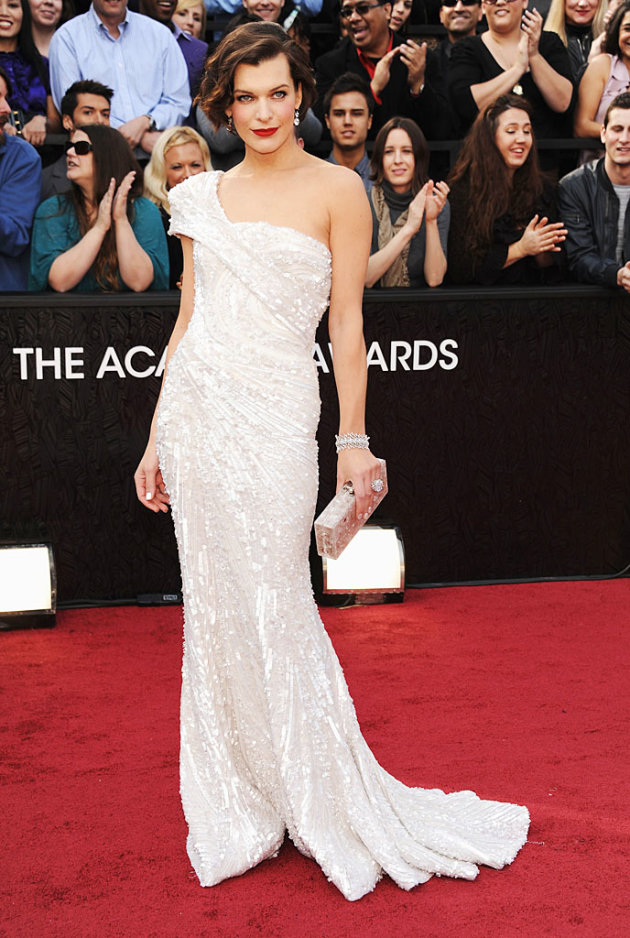
Best and worst dressed at the Oscars
Best:
Milla Jovovich


Rooney Mara


Glenn Close


Kelly Osbourne

Melissa McCarthy

Natalie Portman

Jennifer Lopez

Sherri Shepherd

Busy Phillips

Milla Jovovich
Emma Stone

Octavia Spencer

Rooney Mara

Jessica Chastain

Glenn Close

Gwyneth Paltrow

Penelope Cruz

Worst:
Sandra Bullock

Kelly Osbourne

Melissa McCarthy

Natalie Portman

Jennifer Lopez


Busy Phillips

Sunday, February 26, 2012
Academy Award cupcakes
Don't forget the Oscar's are tonight!
Wizard of Oz (1939)

The Godfather (1972)

Jaws (1975)

Fargo (1996)

Moulin Rouge (2001)

Up (2009)

Toy Story 3 (2010)

Inception (2010)

See more here.
Tuesday, February 21, 2012
How the Oscars are decided

The first Academy Awards ceremony was held in May 1929, over dinner at Hollywood's Roosevelt Hotel. It was attended by 270 people, including some who paid a $5 fee as guests of those with invitations, and was hosted by silent-movie actor Douglas Fairbanks, who handed out the awards in just a few minutes. The 15 winners had been disclosed three months earlier, and the very first Oscar — a 13-inch-tall gold-plated statuette designed by MGM's art director, Cedric Gibbons — had already been presented to German actor Emil Jannings, who had sailed to Europe a few weeks before. The silent-movie star was actually the runner-up in the leading-actor category. Celebrity dog Rin Tin Tin had picked up more votes, but was denied the award by an embarrassed academy.
How did the Oscar get its name?
Legend has it that a librarian at the Academy of Motion Picture Arts and Sciences, which awards the prizes, took a peek at a statuette and said, "Gee! He looks just like my Uncle Oscar." The name stuck, and so did the "Little Man," which remains the single most prized award in the movie business. And this year's 84th Oscar ceremony will be much like the previous 83, with studio bosses, actors, directors, sound editors, and makeup artists doing their utmost to be called up on stage. Their fate rests on the votes of the Academy's members, whose numbers have climbed from 36 in 1927 to 5,783 today.
How do you become a member?
You're either invited to join after being nominated for an Oscar, or you're elected by at least two other members for your services to the film industry. Members join for life, making the Academy a large and unwieldy band: Among those in this select club are anonymous insiders, major Hollywood players like Steven Spielberg, and the occasional outlier, like Mother Dolores Hart, a 73-year-old Benedictine nun who appeared opposite Elvis Presley in 1957's Loving You.
How does the Academy vote?
It has used the same Byzantine voting system since 1936. In stage one — choosing the nominees — members of the Academy's 15 branches vote in their own fields. So directors vote for Best Director, cinematographers for Best Cinematography, and so on, with each voter naming five choices in order of preference. (Everyone gets to nominate for Best Picture). Using a complex system to weight the votes, auditing firm PricewaterhouseCoopers then tabulates the results and determines the top five nominees in each category — or the top nine, in the case of Best Picture. Stage two — choosing the winner — is simpler. All members are allowed to vote in each category, and the nominee with the most ballots wins the statuette.
What's wrong with the system?
Not only is it confusing even to the members of the Academy, it produces some very puzzling results. The movie industry's most prestigious honor somehow managed to elude Orson Welles, Alfred Hitchcock, Richard Burton, Cary Grant, and Greta Garbo. Academy voters chose How Green Was My Valley over Citizen Kane in 1942, and Rocky ahead of Taxi Driver in 1977. Critics of the Oscars say the Academy's voters routinely discriminate against certain genres — comedies, science fiction, and Westerns — and shrink from any kind of controversy and "brave" filmmaking, instead favoring strong, crowd-pleasing story lines. Popularity, in other words, often trumps art.
How is the system to blame?
The biggest problem is that the average Academy member is 57, white, male, and looking for his next Hollywood project. Only a minority, some 1,500, are actors or directors. The rest are the producers, set builders, visual-effects specialists, sound guys, and PR execs that make the industry tick. They're known as the "steak eaters," because they're mostly red-blooded males, and when it comes to the decisive second round of voting, they are by far the Academy's largest voting bloc. "Call it the steak-eater vote, call it the old-geezer vote, call it the babe vote. They always vote for the babes," says Jeffrey Wells, who runs Hollywood-Elsewhere.com. Steak eaters are not big fans of films with gay or foreign themes, like Brokeback Mountain or Munich, and in any given year, about 700 of them will be associated with an Oscar-nominated film, quietly lobbying their peers on its behalf.
Does winning matter?
You bet. In crude financial terms, winning an Oscar, or even being nominated, can have a huge effect on a film's success. U.S. ticket sales for Slumdog Millionaire jumped more than 200 percent when it was nominated, in 2009. Studies have shown that nominations alone can extend a film's presence in cinemas for weeks. At the real business end of Hollywood, however, Oscars are a bonus but don't massively boost the grosses of box-office smashes. Of the top 50 grossing films of all time, just three have won Best Picture: Titanic, Forrest Gump, and Lord of the Rings: The Return of the King.
How to win an Oscar
When it comes to winning an Academy Award, it pays to be a drama queen. A study by the University of California, Los Angeles, and Harvard University found that performers who appear in a drama rather than a comedy are nine times more likely to be nominated for an award. And actresses are twice as likely to be nominated as their male co-stars. "Because there are fewer female than male performers in films, and both are eligible for the same number of awards, actresses stand a better chance," said sociologist Nicole Esparza. "It's simple arithmetic." Perversely, not showing up at the ceremony — a sure sign that you're an established megastar — can also improve your chances. Marlon Brando didn't pick up his Oscar for The Godfather in 1973. Paul Newman turned down an invite in 1987, convinced he wouldn't win on his seventh attempt. And when Woody Allen's Annie Hall won Best Picture in 1978, he was already tucked into bed in New York, having unplugged the phone and soothed himself to sleep by reading Conversations With Carl Jung.
Source
Subscribe to:
Posts (Atom)