Showing posts with label charity. Show all posts

Friday, November 28, 2014

Homeless man gets his Thanksgiving wish


Less than two weeks ago, NewsChannel 3 shared the story of a homeless man staying at a Norfolk mission who posted his request online for a family to take him in for Thanksgiving.

And this Thanksgiving, Neal Shytles got exactly what he was looking for – a family to spend the day with.

After his story went viral, Neal was overwhelmed by how many people nationwide who reached out to him.

It was Ashley McLemore and her husband Cory, a military couple in Newport News, that reached out to Neal first. And Neal accepted their offer.

They picked Neal up from the Union Mission on Thanksgiving morning and took him back to their house to spend the day with them.

“He is a wonderful person who is selfless and I’m so blessed that he’s going to be part of our family,” Ashley says.

Neal seemed to fit right in with the rest of of the McLemore family, exchanging stories and sharing a warm Thanksgiving Day meal with all the trimmings.

He even got to carve the turkey!

But what Neal didn’t expect was that Cory’s coworkers also wanted to help him.

“They have actually donated $400 directly to you. And this was done in two days. They did everything they could to help you out,” said Cory.

The gift broke Neal down to tears.

“You didn’t have to do this. I just wanted a meal,” Neal says.

Now the Union Mission in Norfolk, where Neal has spent the last year and a half, is getting much needed donations because Neal had the courage to reach out.

“I hope people learn that the homeless are not what sometimes you picture the homeless to be,” Neal says. “I could sit there and just cry because people are doing so much for the homeless now.”

Tuesday, May 13, 2014

Lawyers Have Heart Race


Hi my lovely readers!

I'd like to take a moment to announce that I am running in a 10K race (my first!) for the Lawyers Have Heart foundation to support the American Heart Association. This event will help raise money for heart disease and stroke education and prevention. My grandfather passed away last year after suffering from a stroke and I am running in his honor.

I am currently 20% towards my goal of $500. Any contribution is appreciated! No donation is too small: http://www.RunLHH.org/debraewong

Thank you!

Tuesday, March 18, 2014

Little of Lady Gaga's charity actually goes to charity

Splash News
Lady Gaga’s charitable foundation gave out millions in 2012 — to lawyers, accountants and publicity teams, tax records show.

The pop superstar’s fledgling Born This Way Foundation spent $429,682 on outreach with its wildly popular “Born to Be Brave” 23-event US bus tour, but the effort dimmed in comparison with what Gaga’s coterie of consultants pulled down, according to the charity’s 2012 filing.

The nonprofit — which took in $2.65 million in revenue — paid out a staggering $406,552 for legal fees, $300,000 for “strategic development” and $150,000 for “philanthropic consulting,” the latest filings show.

Fees added to the hefty expenses. They included $348,000 for the bus-tour production; $77,923 for travel; $62,836 for stage production; $60,000 for research; $58,678 for publicity; $50,000 for social-media development; and $47,825 for meeting and event coordination.

Total expenses came to $1.85 million.

Among all that, the foundation paid out a single $5,000 grant.

In terms of do-gooding, the foundation — for which Gaga’s mom, Cynthia Germanotta, serves as unpaid president — claims it had nearly 19,288 young participants learning about civic engagement during last year’s summer bus tour. It also claimed 24 kids participated in a youth advisory board summit to help guide the charity’s future programs.

The forms do not spell out the source of the charity’s contributions and income, but Gaga announced in 2011 when she launched Born This Way that she would be funding the bulk of it.

The singer is known for her charity give-backs.

In 2012, she and fellow chart-topper Taylor Swift topped the list of DoSomething.org’s “Top 20 Celebs Gone Good” list.

According to the list, Gaga launched the Born This Way fund with a personal $1.2 million donation and also gave another $1 million to victims of Hurricane Sandy.

Gaga’s foundation said that all its expenses are well worth it.

“Every dollar spent across these categories, including the legal fees towards the safe and effective implementation of each initiative, directly serves the Born This Way Foundation’s core mission of empowering youth,” a statement read.

Gaga, meanwhile, is scheduled to give the keynote address at the South by Southwest music festival and conference in Austin, Texas.

In an interview with Rolling Stone magazine, she promised to give festival fans an experience they will never forget.

“I want the audience in Austin to see me live in a way I never have before,” Gaga said.

Sunday, March 16, 2014

A good reason to put down your smartphone


In this age of the ever-present smartphone and our 'always on' lifestyle, requesting that people leave their phone alone for even a brief span of time is a hard thing to ask, but in this case, instead of harping on the lack of manners that some gadget addicts display, you can point out the potential benefit to others that doing so can have.

As part of the UNICEF Tap Project, people are being challenged to give up something they take for granted, their cellphones, in order to help supply something that's not taken lightly in many parts of the world, which is access to clean drinking water.

If you can put down your phone for just 10 minutes and leave it untouched the whole time (I know, it's rough), Giorgio Armani, the current sponsor of the Tap Project, will donate enough money to pay for a day's worth of safe water for a child in need.
"UNICEF Tap Project is working to help the 768 million people around the world without access to clean water. This year you can help by taking a challenge to give up access to something far less vital than water–your cell phone. 
For every 10 minutes you don’t touch your phone, our sponsor can provide one day of clean water for a child in need."
Ready to begin? All you have to do is use your phone to navigate to the UNICEF Tap Project, follow the prompts, and then set your phone down and do something else constructive for just 10 minutes. The site accesses the accelerometer in your phone to determine if you're actually leaving it alone for the whole time, and if you move the phone, it asks you to put it down to continue.

While you're waiting to get back onto Instagram or Facebook, a timer is displayed on the mobile site, along with a series of water messages and comparisons that put things in perspective for those of us who've got no problem with getting clean drinking water every day of the week.

So go ahead. Put down your phone and help fund clean safe drinking water for a child in need.

Source

Wednesday, December 11, 2013

NFL player Andre Johnson gives back to children in need with toy giveaway


Texans wide receiver Andre Johnson hosted his seventh annual holiday shopping spree at Toys ”R” Us on Tuesday morning. The event gives 12 children selected by Child Protective Services 80 seconds to fill their bins with as many items as possible, compliments of the Andre Johnson Charitable Foundation.

Each youngster paired up with a Houston Texans Cheerleader and raced through the aisles, stocking up on merchandise ranging from dolls to scooters to iPads. Every child was also guaranteed an entertainment system of their choice and two video games.

“I remember times where I wasn’t able to get things that I wanted,” Johnson said. “It just gives them a chance to go through the store and get whatever they want. They don’t have to ask anybody for it. Whatever they have on their Christmas list they can pick up.”

Eighty seconds was enough time for a dozen kids to do some damage, as Johnson’s foundation picked up the $17,352 tab on a receipt about a mile long.

“I think he’s awesome for doing this,” one of the participants, Arlyssa, said after picking up her dream Christmas list. “I like toys and shopping.”

“I think I was a little bit more into than she was,” Houston Texans Cheerleader Gelesann joked. “It was so much fun. We’re so thankful to have players like Andre on our team.”

Similar to the way the Texans prepare to face an opposing team, many of the children had scoped out the area and formulated a game plan. Not surprising to Johnson, all of the kids made a point to grab gifts for their siblings, as well.

“The kids have done that every year,” Johnson said. “That’s big of them. That just shows there in a blessed situation to come and get whatever they want, and they’re not just thinking of themselves. That’s a great deed by them.”

The Andre Johnson Charitable Foundation hosts a number of community events for children in the Houston area and in Johnson’s hometown of Miami. For Johnson, the Toys “R” Us event ranks among the top.

“It’s the holiday season, it’s time for giving. People who know me know I have a good heart and like to give back and help people out. That’s just why I do what I do.”

Tuesday, December 10, 2013

Charity should not be a substitute for justice

On November 15, thousands of people in San Francisco worked together to make an ailing child's wish come true. Miles Scott, a five-year-old boy recovering from leukaemia, dreamed of becoming "Batkid". At the behest of the Make-a-Wish Foundation, a charity which grants the wishes of children with life-threatening illnesses, San Franciscans staged an elaborate series of events for Scott and his family. He rode in the Batmobile, rescued a damsel in distress, and received national press coverage and a personal message from President Barack Obama.

The public effort for Scott shows what a difference kindness and compassion can make for a family in need. But one of the reasons the Batkid outreach was so moving is that it is such a rare occurrence.

In an era where bad luck is mistaken for bad character, the plight of those worse off tends to be ignored or portrayed as a perverse form of retribution. Poverty becomes both a crime and its own punishment, even for children. In many US schools, a child who cannot come up with lunch money is expected to go hungry. In Texas, a 12-year-old's lunch was thrown in the trash because he could not come up with 30 cents.

The outreach for Batkid was celebrated as a triumph of the human spirit. But what it demonstrated is how much better society could be if generosity were consistently applied towards all, instead of concentrated into brief celebratory affairs.

"Charity is no substitute for justice withheld," Saint Augustine once declared. This is painfully clear in San Francisco and its surrounding area, home to some of the highest income inequality in the country.

"San Francisco itself is turning into a private, exclusive club," noted Anisse Gross in The New Yorker. "The city, long reputed as a haven for provocateurs and cultural innovators, has quickly transformed into a playground for the rich, where tech money sends rental prices soaring as the less fortunate tenants battle it out with the rent board."

As journalist Alyssa Rosenberg argues, Batkid was supported by the tech community, who saw the event as a way to indulge in their own superhero fantasies. Yet the broader message of the tech community is that most children do not deserve to be saved. Silicon Valley is a region of "masters and servants", where homelessness has increased 8 percent, as salaries skyrocket. A proposal for Silicon Valley to secede and therefore deny taxpayer money to social programmes benefiting low-income residents, including children, was met by many with approval.

Charity as a substitute
Charity, as a supplement to justice, should be applauded. But charity as a substitute for justice is neither charity nor justice. It is cruelty.

The same week that the nation cheered a charitable effort to make one child's wish come true, the largest employer in the US held a charity drive for some of its own workers. Wal-Mart, whose six heirs to the company fortune have as much wealth as the bottom 42 percent of Americans, pays its workers salaries so low that many qualify for food stamps.

The costs are then transferred to taxpayers. A report by the House Committee on Education and the Workforce estimated that one Wal-Mart Supercenter employing 300 workers could cost taxpayers at least $904,000 annually.

Yet instead of raising salaries to allow employees to live above the dole, Wal-Mart encourages charity - a common panacea to social plight. Universities employing adjunct professors, who are also paid below poverty wages, have held similar food drives for their employees.

In September, Margaret Mary Vojtko, a Duquesne University professor, who had worked at the school for 25 years, died in abject poverty with an annual salary of less than $10,000. Responding to accusations of callousness, Duquesne noted that they had offered Vojtko charity, such as an offer to fix her furnace. ASlate article promising the "real story" of Vojtko argued that she brought her troubles upon herself by refusing Duquesne's gifts while working with a growing movement of adjuncts attempting to unionise.

In other words, Vojtko refused charity while pursuing justice. This is not a position to condemn.

Fiscal stability that relies on gifts is not stability. It is a guarantee of insecurity: income based not on work but on whim. Capricious generosity is not a replacement for a living wage, nor is it a basis for a functioning society. Charity is no substitute for justice.

Living on a gamble
In rural Missouri, there is a store called Nick's Gun and Pawn. Locals can trade their weapons for household items, or vice versa.

It is one of many examples of one of the most overlooked stories in the great recession: the explosion of pawn shops and payday loan outlets throughout the US. Between 2009 and 2011, the rate of Americans using high-cost nonbank credit soared to 14 percent, and included a rise in population segments once considered economically advantaged, but now unable to afford daily needs.

Pawn shops and payday loans are the flip side of the US' turn to charity over justice. Both phenomena speak to a seemingly permanent impermanence: The replacement of a reliable salary for hard work, with high-cost gambles and unpredictable donations.

In much of the US, possessions are not things you own. They are disaster protection, what you trade to survive. The consequences are not only material but psychological. When you are constantly gambling, the future comes to look like a bad bet.

Journalist Gillian Tett notes that poorer Americans, living check to check, are "more likely to perceive the future as a chaotic series of short-term cycles". When people are expected towork unpaid for the promise of work, the advantage goes to those immune from the hustle: the owners over the renters, the salaried over the contingent. Attempts to ensure stability and independence for citizens - such as affordable healthcare - are decried as government "charity" while corporate charity is proffered as a substitute for a living wage.

"We don't plan long-term because if we do, we'll just get our hearts broken," wrote Linda Walther Tirado, a blogger who described her own struggle with poverty in a much circulated essay. "It's best not to hope. You just take what you can get as you spot it."

"Taking what you can get" is also the path pursued by corporations and people who prefer cheap acts of charity to long-term investments in justice. It is a path that encourages citizens to depend on arbitrary generosity while decrying stable programmes that help people through tough times. It trades in racialstereotypes, portraying the poor as lazy, violent and "undeserving" of either assistance or the benefit of the doubt.

On November 23, East Saint Louis, an impoverished city with a high rate of gun violence, offered a trade to city residents: bring in your gun and receive a $100 gift certificate at a local grocery store. At 9 am, a long line had formed of residents with guns in hands. Within ten minutes, $10,000 of grocery store gift cards had been given away.

Some were surprised by the outcome. They should not have been. Ours is an economy of survival. Violence is often the last resort for people out of options. When presented with options, they chose food.

Charity, for the giver, is the trade of cash for a moral fix. As the Make-a-Wish showed, charity can be beautiful. But it is an investment in the present, not the future. If you value the future - if you value a society where people can imagine their future - work for justice.

Monday, November 25, 2013

Gay waitress denied tip giving donations to Wounded Warrior Project

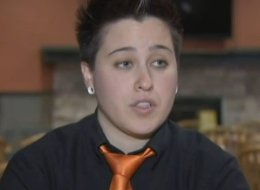
An openly gay waitress and Marine who was stiffed on a tip because of her "lifestyle" has received an outpouring of support from the public since her story went viral. Now, she wants to pay it forward.

Dayna Morales, a server at Gallop Asian Bistro in Bridgewater, N.J., made headlines last week when she posted her encounter with homophobia to the "Have A Gay Day" Facebook page. Instead of leaving a tip on a $93.55 bill, a family of diners ridiculed Morales and scrawled an anti-gay note on the receipt, that read: "I'm sorry but I cannot tip because I don't agree with your lifestyle & how you live your life."

She took to Facebook to air her grievances about such treatment, explaining, "I served in the Marines to keep ignorant people like them free."

The story wound up exploding online, and Morales received an influx of messages and donations from around the globe.

"People have sent me tips from all over the world just to show support. I have had people from Germany to South Africa, Australia to the U.K., San Diego, everywhere," she told CNN, adding that she received around $2,000. "It wasn't for the money. I never planned on this. I just wanted to vent. The purpose was to inform people it wasn't OK."

Now Morales wants to help others by giving a portion of the donations to the Wounded Warrior Project to help injured servicemen and women, according to NJ.com.

"I plan -- being a veteran -- to send a portion of it to the Wounded Warrior Fund," she told WNBC. "It's great to see everybody's support and I'm thankful for it, but it doesn't excuse or change the fact that it actually did happen."

Morales' employer reportedly plans to match every donation.

The waitress also told the Asbury Park Press that her boss was not mad she posted the check to Facebook.

“We are kind of a big family so they all took it to heart," Morales said about her coworkers' support. "My manager assured me that if they had seen the check before the family left they would have confronted them."

Morales served in the Marines from 2009 to 2011.

Friday, November 22, 2013

How donating clothes may do more harm than good

Secondhand shopping is something we hold near and dear. It's the way many fashionphiles come to love brands like Prada or Versace in more intimate ways, beyond just seeing them in magazines. Those occasional rare finds, in addition to the many, many awesome '90s revival pieces we've found buried in the racks at Salvation Army, are a source of pride (not to mention an adrenaline rush) for many of us. Plus, it's an easy way to turn your shamefully excessive spending habit into something that actually does some good for the world.

But, as Tansy Hoskins points out in this fascinating op-ed for Business of Fashion, it might not be quite as rosy as it sounds especially when it comes to the donated, sold in bulk, and shipped at low cost distribution of Westerners' clothing to markets in areas like sub-Saharan Africa. These goods can actually make a considerable profit, even though many are donated. Then, there's the issue that the massive influx of clothing into these areas suppresses the growth of local textile markets.

It's a further cost of the fast-fashion cycle. Clothes are purchased without a whim, donated practically unworn, and forgotten about with the vague sentiment that you've done a good deed. And, while providing clothing to those in need is not a bad thing in and of itself, the point here is that it's a complex process with more consequences than those donating might realize. It's not unlike the same debate behind whether or not we should be pouring aid money into foreign countries or working to stabilize and promote prosperity in other, more substantial ways. In short, there's a lot to be said for either side of the argument.

Monday, November 11, 2013

How you can help those affected by the Philippines typhoon

The damage in the Philippines has been extensive. President Benigno S. Aquino III has declared a “state of calamity” in hopes of releasing emergency funds from the government. However, much of their funding has been depleted after many other natural disasters in the area this year, including the 7.1 magnitude earthquake that hit the islands just a few weeks ago. This means that foreign aid may be even more important than first thought. Here is how to help.

1. Oxfam International

oxfam.org

Who they are: “Oxfam is an international confederation of 17 organizations networked together in more than 90 countries, as part of a global movement for change, to build a future free from the injustice of poverty.”

What they’re doing: Oxfam has sent experts to assess the damage in the region. “Making sure people have clean water, safe sanitation and a roof over their heads [is our] immediate priority. These disasters compound the burden of Philippines’ poorest people. Small scale farmers and those relying on fishing to make a living will be hardest hit. Their fields and their boats and tackle will be badly damaged and they will need help not only today but in the months to come,” said Marie Madamba-Nuñez of Oxfam in the Philippines.

How you can help: Donate at their website here.

2. Save The Children

savethechildren.org

Who they are: Save the Children works to give children a healthy start, the opportunity to learn and protection from harm. In times of natural disaster they put children’s needs first.

What they’re doing: Save the Children is sending household kits, education kits and hygiene kits for children in the Philippines. They estimate that up to 7,000 schools could have been damaged by the storm.

How you can help: Donate on their website here.

3. World Food Programme

wfp.org

Who they are: The WFP is “the world’s largest humanitarian agency fighting hunger worldwide, reaching more than 97 million people in 80 countries with food assistance last year.”

What they’re doing: WFP has started to send food to the Philippines, mobilizing an immediate $2 million. So far they have sent over 400,000 high energy biscuits to the region. These biscuits are nutritious, and do not need to be cooked, making them the ideal food for the cities now left without electricity.

How you can help
: You can donate $10 by texting AID to 27722 or you can head to their website to donate more.

4. AmeriCares

Americares.org

Who they are: AmeriCares is “a non-profit emergency response and global health organization. In times of epic disaster or daily struggle, they deliver medical and humanitarian aid to people in need worldwide.”

What they’re doing: AmeriCares has sent an emergency shipment with enough medical aid for 20,000 survivors. These kits include antibiotics, wound care supplies and pain relievers. The organization is also providing funding to allow their partner organizations to purchase and distribute critical relief supplies on the ground.

How you can help: Donate on their website here.

5. Red Cross

redcross.org

Who they are: “The American Red Cross shelters, feeds and provides emotional support to victims of disasters; supplies about 40 percent of the nation’s blood; teaches skills that save lives; provides international humanitarian aid; and supports military members and their families.”

What they’re doing: The American Red Cross has started assessments of what is needed in the Philippines. They have activated their family tracing services for those unable to reach their loved ones in the region. International Red Cross teams are making plans to head to the region in the coming days.

How you can help: You can donate at their website here or you can send a check to your local chapter.

Wednesday, October 9, 2013

Waitress receives $10,000 tip after racist receipt

A Tennessee Red Lobster waitress has received a huge tip from a group of strangers after saying she experienced racism on the job.

Last month, Toni Christina Jenkins, 19, claimed a customer wrote "none" under the tip section of his bill and wrote the n-word for the total.

She posted a picture of the bill on Facebook, saying “This is what I got as a tip last night… so happy to live in the proud southern states...God Bless America, land of the free and home of the low class racists of Tennessee.”

The customer, Devin Barnes, has publicly denied using the epithet -- although he admits writing "none" -- and has hired a lawyer, according to the New York Daily News.

The story went viral, prompting support and threats for Jenkins, who was temporarily suspended from her job.

A California man set up a fundraising page for Jenkins that raised more than $10,000.

Wednesday, September 25, 2013

Couple feeds 200 homeless people after calling off wedding


When an engaged couple calls off the wedding, it is usually a time of sadness and anger. But one family in Atlanta found a way to turn a terrible situation into a beautiful one. Carol and Willie Fowler's daughter Tamara was set to get married at the Villa Christina catering hall, when the wedding was called off just 40 days before the event. Initially the Fowlers were upset to hear that the lavish gathering they had planned and paid for was not going to happen. Then they had a genius and generous idea: They invited 200 of the city's homeless to feast on the four-course meal that would have been part of Tamara's wedding reception.

The Fowler family called Elizabeth Omilami from the Hosea Feed the Hungry organization for her help in getting the group together. At first Omilami thought she was being pranked! Carol Fowler said that even daughter Tamara attended the event, adding, "She was also very delighted to see and know that others had an opportunity to enjoy something, rather than just allow it to go to waste." Children make up about 70 percent of Atlanta's homeless, so to make the dinner more fun for them, a clown was hired for their entertainment. The event was titled "The First Annual Fowler Family Celebration of Love," and the family says it plans on hosting another charity dinner next year. It's a great example of how you can turn any bad situation into a positive one.

Wednesday, September 18, 2013

Alabama man raises over $50k for a Boston homeless good samaritan

A homeless man living in Boston had no idea he would become the talk of a nation after he summoned a nearby police officer to hand over a backpack he'd found with more than $40,000 in cash and travelers checks inside.
There are two reasons why this story renews faith in humanity. First, the simple fact that the backpack was returned when the man could have easily pocketed some quick cash. Glen James got his reward in the form of a special citation from the Boston Police Department, but if he thought that was the end of it, he was wrong.

The second reason comes as Montgomery, Alabama native Ethan Whittington read of James' story and decided to take action.

Whittington, who graduated from Montgomery's St. James School in 2004, has since moved to Richmond, Virginia, though his parents remain rooted just outside Alabama's capital city. In fact, Whittington's mom told officials at his alma mater that she thinks her son learned some of his volunteer ethic from the community service projects he did while in school.

After reading how James found the backpack and money and then selflessly returned it, Whittington was moved to action. A friend had recently told him about a website for crowd-funding and he decided to set up an account.

Whittington started a page on the website GoFundMe.com, jokingly thinking he could raise $300 or $400 for James. "I was going to send it to the P.O. box that it listed on the article I read," Whittington explained.

The outpouring of support was explosive. Within 24 hours, more than 2,000 strangers had donated more than $55,000 to the cause, shocking even the man who started the page. A new, more ambitious goal of $500,000 is now underway.

Whittington says he's talking with an organization that will help him manage the project adding that he's received offers for computers, clothing and possibly even a job and housing for James.

The two men spoke on the phone Tuesday, and both are a bit overwhelmed.

Whittington says he wanted to do something more than just hand over a check to James, that he wanted to positively influence the man's life, and spark others to do the same.

"I feel like, if everybody could come together and create one goal like we've done for Glen, why stop with him? Why can't we influence more people?" Whittington asked.

If you would like to donate, you can do so HERE.

Source

Tuesday, September 10, 2013

Make D.C. Smile


Make D.C. Smile, a self-appointed group in charge of making people in Washington happy through do-goodery, has launched a new Pay It Forward project that aims to put free coffee in your hands.

With the Blind Dog Cafe on Florida Avenue NW, Make D.C. Smile is helping to give away free coffee and tea purchased by someone else.
Individuals will be randomly selected throughout the day and surprised with a coffee or tea that has been pre-paid by another member in the community. Each coffee that is gifted will include a hand-made coffee sleeve with a positive message! In return, we encourage others to pay it forward and continue spreading positivity by any simple, small act of kindness of their choosing.
The group, which was formed a year ago, is asking people interested in "spreading positivity" to purchase a coffee or tea for someone else at Blind Dog, which is a pop-up coffee shop located in Darnell's Bar during the day.

Members of Make D.C. Smile recently stood on the Key Bridge with signs like "Today is Awesome" and "Chin Up Buttercup" in an attempt to make drivers smile, as WTOP reported. While the sign holding is their most practiced activity, the group was also behind a chalk mural last December that was covered in nice messages.

Update: Make D.C. Smile founder Massoud Adibpour explains how he got the idea for the coffee giveaway.
We got the idea for the project after hearing an NPR radio story about a similar campaign in the European Union, which began as a way to build community and show support for those struggling with hard times. Customers could choose to pay-it-forward by offering to purchase a 'suspended coffee' for another, which could be redeemed at anytime by anyone. We loved the idea, believing that sometimes it's the little things -- like a simple cup of coffee -- that can brighten one's day and propel a powerful movement of generosity and positivity, and we're excited to translate the concept here in D.C. area. We're thankful Blind Dog Cafe agreed to take part in the campaign as the first location, and we're hoping to get many other area coffee shops on board as well.
Source 

Wednesday, July 24, 2013

Three things you didn't know about TOMS shoes

In an age of soaring corporate profits and bloated CEO salaries it may seem like fantasy for a company to put charity before profit. In this Breakout profile, we meet TOMS. On the surface they look like just another trendy footwear company, but for every pair of shoes TOMS sells, a pair gets donated to a kid in need. Last month, after less than seven years in business, they donated their ten millionth pair.

The company’s founder and “chief shoe giver” Blake Mycoskie started the company after vacationing in Argentina in 2006. He competed in there with his sister as a part of CBS’ “The Amazing Race” in 2002, but it was when Mycoskie returned that he met a group of aid workers collecting used shoes and handing them out to children who had none.

“I saw the absolute joy that these kids got and their families got and the gratitude from a simple pair of shoes,” Mycoskie explains in the attached video, “and that’s when I really wanted to do more to help.”

He started small. Mycoskie brought back 250 pairs of shoes from that first trip. They were modeled after a traditional Argentinian shoe called an "alpargata." The plan was to sell them on the boardwalk near his Venice, California home, go back to Argentina with the profits, and make shoes to donate to the kids he saw on his trip.

“I said if we sell a pair of shoes today, we can give away a pair tomorrow and we’ll call them 'tomorrow's shoes,'” Mycoskie explains, “but tomorrow is too long for the little tag, [we] shortened it to TOMS, and of course people have called me Tom ever since.”

Business has exploded since those first 250 pairs of shoes and here are three things you may not know about this philanthropic company, even if you're wearing a pair as you read this.

1. TOMS has no advertising budget
Success came by word of mouth and profiles in publications like the L.A. Times and Vogue. The company has succeeded without outside investors and has never had to buy an ad. “It allows us to stay focused on our mission,” says Mycoskie, “and also allows us to have a long-term vision. That’s a very rare situation in business.”

2. TOMS donations are the highest quality productsTOMS doesn't produce a low quality shoe that's meant to be donated. In fact, it's the opposite. The shoes that are given away are often higher quality than what's for sale on store shelves.

“We have a winter boot now that we make for kids who get frostbite and we have an athletic shoe that we’re giving to kids in America that they can play on the blacktop and do some sports,” says Mycoskie.

3. TOMS donates new shoes when kids grow out of their old pair“Our giving is all about repeat giving,” Mycoskie says. “So we’re not just dropping them off once, we’re building relationships with these communities so not only do the kids gain these shoes as they grow out of them or wear out of them, but they’re also building self esteem because they know those shoes are coming and someone cares about them in that way.”

What started in Argentina has now spread to more than 60 countries around the world. And Mycoskie says it's not just about shoe donation; he's trying to have a positive impact on local economies as well.

“One of the things we’re working on doing over the next couple of years is creating more jobs in the countries where we give shoes," he says. "My goal is by the end of 2015 that a third of our giveaway shoes will be made in-country.”

Another goal for the future is to give away the secrets of TOMS charitable "one for one" business model to other companies.

“I really outline kind of how Toms has done it, how other organizations have done something similar. It might not always be one-for-one but how they incorporate giving into their business, or if they’re a charity, how they’ve used business practices to make their charity more robust and powerful.”

And he's seeking to make TOMS' pace of donation more robust, setting his sights on donating another ten million pairs of shoes in less than two years. Not bad for the 36-year-old businessman from Texas.

Monday, May 6, 2013

You may look at homeless people differently after watching this


Edit: Huffington Post is reporting that there is now an online fundraiser to help get Ronald Davis back on his feet. The money will help Davis secure a stable home, purchase work clothes, and get professional job training. And one kind person also bought Davis a cellphone so he can now give interviewers a number to reach him.