Showing posts with label religion. Show all posts
Showing posts with label religion. Show all posts
Wednesday, April 8, 2015

Sunday, March 2, 2014
Why millennials are less religious
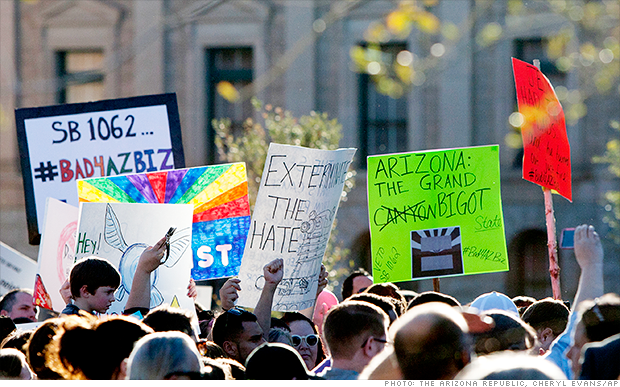 It's no secret that young Americans aren't as religious as their elders. A survey released Wednesday by the Public Religion Research Institute suggests that part of that rift may be attributed to a perceived anti-gay bias in organized religion.
Among those who have abandoned their childhood religion and are now religiously unaffiliated, one quarter say anti-gay teachings factored into their decision to go faithless. Among Millennials in the religious turned irreligious camp, almost one third said the same.
At first blush, that would appear to suggest clear causation: stuffy old anti-gay religious dogma is spooking all the hip youngsters. But while there is certainly a link between the two, it is an overly simplistic analysis that glosses over a host of reasons that Americans — and particularly younger ones — are losing their religion.
Let's start by digging a little deeper into PRRI's survey results. While 31 percent of Millennial religion-droppers said anti-gay teachings were a factor in their decision, only 14 percent called it a "very important" reason they went faithless. And fully two thirds of Millennials who abandoned religion said their decision had very little or nothing at all to do with religion's position on homosexuals.
So what else is at play here?
Americans have been growing less religious for some time now. About one fifth of the nation is either atheist, agnostic, or religiously unaffiliated, according to a 2012 Pew survey, which categorizes that demographic as the "nones." Young adults are less devout than any other age bracket; nearly a third of them are religiously unaffiliated. Notably, they are also less religious than previous generations were at this point in their lives.
As Pew pointed out, that generational divide isn't the result of just one or even a few factors. Rather, it coincides with a general "softening of religious commitment" in the nation as a whole, with religious institutions holding much less influence in Americans' daily lives.
Americans attend church less, are more likely to doubt the existence of God, and are less likely to take the Bible literally than ever before. What that means for Millennials is that they're growing up in less religious households, and are thus less liable to embrace religion themselves.
At the same time, atheism and agnosticism have gradually become more commonplace and acceptable. Only 18 percent of Americans said they would vote for an atheist presidential candidate in 1958; a majority now say they would do just that. There are promotional atheism billboards all over the country, including one that went up near the site of the Super Bowl this year. There's even a hotline to help people "recover" from religion.
On another front, religion has become increasingly politicized in recent years; its perceived anti-gay bias is just one manifestation of that trend. As political scientists Robert Putnam and David Campbell tell it in their book, American Grace, the religious right secured a foothold in modern American politics by railing against abortion, contraception, premarital sex, and other supposedly sinful things including, yes, homosexuality. (The PRRI survey lumps all religions together, but given Christianity's predominance it's worth spotlighting.) That politicization, they argue, then turned nonreligious voters off of the GOP and religion in general. Indeed, religiously unaffiliated voters have been trending more Democratic for the past 30 years, with a spike in the past decade.
"While the Republican base has become ever more committed to mixing religion and politics," Putnam and Campbell wrote, "the rest of the country has been moving in the opposite direction."
Returning to Millennials, the religious positions mentioned above are also largely anathema to their prevailing beliefs. Furthermore, the outright hostility to science from some on the right — on global warming, evolution, and even something as seemingly benign as vaccines — only further impugns religion's credibility with younger voters. It should be no surprise then that solid majorities of Millennials describe Christianity as "hypocritical" and "judgmental."
To be sure, organized religion's perceived views on and treatment of homosexuals are undoubtedly pushing away some Millennials, who as a group are more supportive of gay marriage than the general public. But that's only a small piece of a much bigger picture.
Saturday, January 25, 2014
Why red states have higher divorce rates than blue states
 It may seem counterintuitive, but divorce rates are higher in religiously conservative "red" states than "blue" states, despite a Bible-based culture that discourages divorce.
In a new study titled "Red States, Blue States, and Divorce: Understanding the Impact of Conservative Protestantism on Regional Variation in Divorce Rates," which will be published later this month in the American Journal of Sociology, demographer and University of Austin professor Jennifer Glass set out to discover why divorce rates would be higher in religious states like Arkansas and Alabama -- which boast the second and third highest divorce rates, respectively -- but lower in more liberal states like New Jersey and Massachusetts.
It was previously thought that socio-economic hardships in the South were largely to blame for high divorce rates, however Glass and her fellow researchers concluded that the conservative religious culture is in fact a major contributing factor thanks to "the social institutions they create" that "decrease marital stability."
Specifically, putting pressure on young people to marry sooner, frowning upon cohabitation before marriage, teaching abstinence only sex education and making access to resources like emergency contraception more difficult all result in earlier child bearing ages and less-solid marriages from the get go, Glass writes in the paper.
“It’s surprising,” W. Bradford Wilcox, director of the National Marriage Project, told The Los Angeles Times. “In some contexts in America today, religion is a buffer against divorce. But in the conservative Protestant context, this paper is showing us that it’s not.”
Glass and her colleagues also concluded that the religious culture of the area permeated into the divorce rates of even the non-religious people who lived there. In other words, simply by living in counties which were dominated by conservative Protestantism, people were at a higher risk for getting divorced.
As Glass told The Los Angeles Times, “If you live in a marriage market where everybody marries young, you postpone marriage at your own risk. The best catches… are going to go first.”
Wednesday, December 11, 2013
Saturday, October 26, 2013
How the Pope could tear apart the religious right

In a series of interviews earlier this year, Pope Francis repeatedly signaled a desire for his flock to disengage from the culture wars — complaining that the church had become “obsessed” with issues like marriage and abortion, actively seeking common ground with atheists, and even appearing to flirt with moral relativism. While the new tone coming out of the Vatican has drawn plaudits from progressives, it has also driven a wedge into the powerful political alliance between conservative Catholics and Evangelical Christians that’s been instrumental in electing hundreds of Republicans over the past four decades.
Bryan Fischer, a senior analyst at the American Family Association and devout Christian, said he was “disappointed and alarmed at some of the things the pope said” — a sentiment shared by many of the protestant culture warriors on America’s religious right.
“It raises questions in our mind because the Catholic Church has always been a faithful shoulder-to-shoulder ally to social conservatives in the fight to protect unborn human life” and the sanctity of marriage, Fischer said. “We simply have questions of whether we’ll be able to count on the Catholic Church to be comrades-in-arms to continue to fight these battles.”
Russell Moore, president of the Southern Baptist Ethics and Religious Liberty Commission, struggled to find theological justification for the pope’s comments. In a column earlier this month, he concluded that Francis was guilty of “severing the love of God from the holiness of God” — even as he mused that he was not interested in “refighting the protestant reformation.”
And when Francis seemed to suggest that salvation was possible for atheists as long as they lived moral lives, Christian Broadcasting Network reporter David Brody tweeted, “Say what? Catholics please explain this… Evangelicals are NOT kosher with this.”
From the start of their unlikely alliance, Catholics and evangelicals have always made for strange bedfellows. Before the 1970s, American protestants and Roman Catholics had been locked in a religious rivalry that sometimes expressed itself in nuanced theological debates and just as often devolved into pulpit-pounding sermons rife with fire and brimstone. Considerable swaths of each faith were convinced the other side was going to hell.
It wasn’t until the Supreme Court’s Roe v. Wade decision — and the sexual revolution that presaged it — that the two religions were united in an awkward but enduring marriage of convenience. For the better part of 40 years, Evangelicals and Catholics stood side by side battling the encroachment of secularism, the collapse of traditional sexual ethics, and the general rot of American culture. When Jerry Falwell formed the Moral Majority, he insisted that Catholics be among the leadership. And the coalition only became more focused and influential after the Soviet Union collapsed, when politically-minded priests in the U.S. who had spent much of their energy railing against the evils of communism shifted their homilies to pro-life commentary.
Their combined political influence became a driving force in the Republican Party, forming a movement that launched a thousand HBO boycotts and helped elect George W. Bush. Then Pope Francis came along.
To be clear, conservative Catholics in the U.S. are not exactly laying down their weapons of culture war and withdrawing from the battle en masse. They believe the secular media have blown the pope’s recent remarks out of proportion, and they note that the church’s doctrine has not changed. Matt Smith, president of the conservative organization Catholic Advocate, said there is nothing new in what Francis has been saying. “It’s hate the sin, love the sinner,” he said. “He’s encouraging folks to make sure that we’re still loving the person. In no shape or form is he endorsing same-sex marriage.”
But Francis’ approach has managed to resurface evangelical activists’ long held — and long concealed — skepticism toward their Catholic peers. It’s a dynamic that was on display earlier this month at the Values Voter Summit in Washington.
Asked if he was concerned that the new pope would lead catholics away from political engagement on social issues, Family Research Council President Tony Perkins demurred: “I’ve only seen the articles. You cannot base a conclusion on one article, one statement, one speech. It’s cumulative.”
But then he offered what seemed like a veiled admonishment: “Those that subscribe to Biblical orthodoxy know what the teachings are when it comes to sexual morality. You can’t change that unless you ignore or change the word of God.”
Meanwhile, away from the gaggle of reporters, Tracy Pyland, a born again Christian and Maryland mother of five who came to the conference with her husband and two youngest children, was less diplomatic when asked about the pope’s recent comments.
“That’s infuriating. That man needs to read his Bible,” she said.
She hastened to add, “I don’t mean any disrespect, but that man garners a lot respect and he should earn that respect. He should not have done that… He’s not doing the job he was given, which is to represent Christ in a positive light.”
Friday, October 11, 2013
Pope Francis is serious about cleaning up the Catholic Church
 In some respects, the Catholic Church is like any giant, multinational organization. It has some amount of corruption, bureaucratic dysfunction, even crime. But it's also a religious institution, which we generally (and rightly) hold to higher ethical standards than, say, Coca-Cola or ExxonMobil. The Catholic Church is also different in that its chief executive, the pope, has more control over his organization than any CEO.
Since his election in March, and especially in the past few months, Pope Francis has really shaken up the tone and timbre of the church, particularly in its attitude toward controversial issues like gay marriage and abortion. And people have noticed. Even observers prone to be more critical of the Holy See, like The Daily Show's Jon Stewart, are cautiously welcoming a new morning at the Vatican. On Wednesday, President Obama shot some praise the pope's way, too. "I have been hugely impressed with the pope's pronouncements," Obama told CNBC, when asked.
Obama added that Pope Francis' open-armed "spirit, that sense of love and unity, seems to manifest itself in not just what he says, but also what he does." But that touches on one of the criticisms (or accolades, depending whom you ask) of the new pope: He says all the right things, but outside of his personal habits and interactions, he isn't really backing up those words with action.
That may be changing.
On Tuesday, the 125-year-old Vatican Bank — formally called the Institute for Religious Works —released its first earnings report. Ever. That's not all Pope Francis' doing. He has cracked down on financial malfeasance and created a new commission to audit the bank, but Italian financial authorities got the ball rolling in 2010 by seizing $30 million in bank assets and investigating its (now former) president in connection with money laundering. Pope Benedict XVI set up a Financial Intelligence Authority to keep the bank honest in 2011.
Also this week, Pope Francis met with a special council of eight cardinals he has impaneled to make recommendations on how to reform the church, which possibly includes a big shake-up of the Vatican's infamous Curia, or bureaucracy. It was the group's first meeting. On Wednesday, Vatican spokesman Rev. Federico Lombardi called the summit "encouraging," but said the council wouldn't release any documents or public statements.
The same day, however, Andrea Tornielli at La Stampa's Vatican Insider got a pretty big scoop: The pope proposed to his gathered cardinals a revamping of the way the church litigates sexual abuse allegations against priests and other Catholic clergy. The idea is to set up regional or country-specific ecclesiastical courts that would handle sex abuse cases. This is potentially a very big deal.
"Although Pope Francis has earned a reputation for taking on tough questions and shaking up the status quo," says John Allen Jr. at the National Catholic Reporter, "so far he's been relatively quiet on at least one issue that's arguably done greater harm to the image and morale of the church over the last decade than any other: The child sexual abuse scandals." Allen explains what the new system would look like:
At the moment, church law requires bishops to submit charges of abuse against clergy to the Congregation for the Doctrine of the Faith in Rome, which determines if there's sufficient basis to proceed. After its review, the congregation generally sends the case back to a local court, but those bodies sometimes lack the personnel and resources to handle [such cases] efficiently.
The idea behind national or regional tribunals would not only be to ensure that cases are processed swiftly, but also to enforce a uniform standard of justice, so that outcomes don't hinge on where the case originated. If Francis makes creating such tribunals a priority, it would be read as a clear signal that he wants to fill the gaps in the church's response. [National Catholic Reporter]If, on the other hand, the pope takes a lesser step, like transferring authority over sex abuse cases from the powerful Congregation for the Doctrine of the Faith to the sometimes inefficient Roman Rota court, says Allen, "insiders might read it as downgrading the importance of the effort" to combat child sex abuse. Francis could also take bolder measures, like creating a new Vatican department focus on sexual abuse, or start tossing out bishops who mishandle abuse cases.
But that might be a step too far, even for this pope. "He has only been in the job for six months, and his promise of reforming the Curia may just be the tip of the iceberg," says Barbie Latza Nadeau at The Daily Beast. His moves so far — replacing Secretary of State Tarcisio Bertone, stopping the practice of granting elite priests the title of "monsignor," and suggesting that divorce and abortion may not bar contrite Catholics from taking Communion — have already "upset many of the Vatican's traditional insiders," Nadeau adds.
When the G-8 cardinals finish their reform summit, they will accompany Francis on his Assisi pilgrimage before going back to their home diocese. Then the pope is expected to get to the real work of tough reform, using the summit as a launching pad. No one knows exactly what those reforms will look like, or whether they will eventually dip into doctrine, but one thing is clear: The road ahead will not be an easy path to follow, even for a pope as popular as this one. [Daily Beast]Still, in the church, words and tone matter. Giving wide-ranging, unguarded interviews to atheists and Jesuits makes a difference. For conservatives dismayed by Francis' freewheeling papacy, says Matthew Schmitz at First Things, "it is no use pretending there's nothing significant in this new approach."
Francis really does mean to reform the Curia and renew the church, tasks that are both urgently needed and impossible to do in a way that will please all. His initial moves in this area are overwhelming positive, I think, but only time will tell. Pope Francis wants a dialogue with the world conducted in the manner of an after-dinner conversation. We might question Francis' choice, but demanding precision once it's been made is as pointless and ill-mannered as quibbling after dessert. [First Things]Source
Friday, June 8, 2012
New poll shows that the majority of Americans support gay marriage
A majority of Americans — 54% — say same-sex marriages should be legally recognized, while 42% are opposed, according to a CNN/ORC International Survey released Wednesday.
The poll showed a sharp partisan divide on the issue, with seven in 10 Democrats as well as six in 10 independent voters saying same-sex marriages should be legal, and 72% of Republicans opposed.
President Barack Obama announced his support for same-sex marriage in an ABC News interview in early May, but Mitt Romney says he does not support gay marriage or civil unions.
The poll results come the day after the Ninth U.S. Circuit Appeals Court in San Francisco declined to revisit its earlier decision that ruled California's Proposition 8 unconstitutional and said gay and lesbian couples could marry.
The poll also found that the number of Americans who say they know somebody who is gay has jumped from 49% in 2010 to 60% now.
The CNN poll was conducted by ORC International from May 29-31, with 1,009 adults nationwide questioned by telephone. The survey's overall sampling error is plus or minus 3 percentage points, with a sampling error of plus or minus 3.5 percentage points for registered voters.
Source
In related news, over 300 active Mormons, part of a “Mormons Building Bridges” initiative, marched in the gay parade as part of the Utah Pride Festival. Now this has been happening for a few years now but major new outlets have finally started to take notice.


The poll showed a sharp partisan divide on the issue, with seven in 10 Democrats as well as six in 10 independent voters saying same-sex marriages should be legal, and 72% of Republicans opposed.
President Barack Obama announced his support for same-sex marriage in an ABC News interview in early May, but Mitt Romney says he does not support gay marriage or civil unions.
The poll results come the day after the Ninth U.S. Circuit Appeals Court in San Francisco declined to revisit its earlier decision that ruled California's Proposition 8 unconstitutional and said gay and lesbian couples could marry.
The poll also found that the number of Americans who say they know somebody who is gay has jumped from 49% in 2010 to 60% now.
The CNN poll was conducted by ORC International from May 29-31, with 1,009 adults nationwide questioned by telephone. The survey's overall sampling error is plus or minus 3 percentage points, with a sampling error of plus or minus 3.5 percentage points for registered voters.
Source
In related news, over 300 active Mormons, part of a “Mormons Building Bridges” initiative, marched in the gay parade as part of the Utah Pride Festival. Now this has been happening for a few years now but major new outlets have finally started to take notice.


Wednesday, May 30, 2012
Anderson Cooper interview with a crazy woman
Here's his interview with Stacey Pritchard — a staunch defender of her Pastor Charles Worley, even after he recently suggested on the pulpit that gays and lesbians should be put into an electrified pen to “kill them off.” I don't know how he doesn't completely lose it when she fails to understand the most basic reasoning or simple questions.
Saturday, May 5, 2012
Thursday, February 23, 2012
Book Review: Have A Little Faith
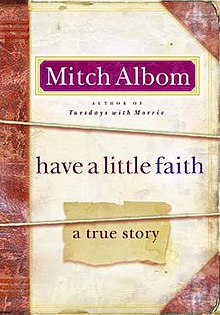
Mitch himself grew up in a Jewish household and was very involved in his synagogue. When his daily life was consumed with work and family obligations, his faith took a backseat and became almost non-existent. His conversations with Reb not only help Mitch understand faith better but he reinvigorates his faith through his friendship with a Protestant pastor named Henry. These two, very different men from very different backgrounds reveals to Mitch the power of faith in their communities.
The book explores faith separate from religion which is appealing for those who consider themselves religious and those who do not. What I liked about the memoir is that it doesn't shove one view in your face - but the universal idea of faith that spans every culture, religion, and background. It's a very quick read (I finished it during my three hour train ride from NYC) but it will really make you think.
Tuesday, October 25, 2011
Scientologists spent a long time investigating South Park for making fun of them

According to those documents, Scientology operatives staked out the South Park production offices to compile personal information on the staff, and even concocted schemes to infiltrate the writers’ room using a Church plant who’d worked for Troma Entertainment’s Lloyd Kaufman. Through that mole, the Church established “leads” on several friends of Parker and Stone—including then-married couple John Stamos and Rebecca Romijn—whom they also targeted for “PRCs” (public records checks) and “special collections,” which Rathbun explains to the Village Voice is a Scientology code word for digging in the trash and looking for anything they can use against you, be it phone records and bank statements or even empty bottles of liquor and food containers that could help them “figure out your diet.” Unfortunately for the Church of Scientology, they were apparently thwarted in their attempts to dig through Parker and Stone’s trash. Thus, they were unable to put together the detailed description of their diets that would prove, once and for all, that the Church of Scientology is not a creepy cult built on subterfuge and intimidation tactics. Without it, the case is still somewhat open.
Source
Wednesday, October 19, 2011
Interesting article about religion, politics, and science: The Evangelical Rejection of Reason

The rejection of science seems to be part of a politically monolithic red-state fundamentalism, textbook evidence of an unyielding ignorance on the part of the religious. As one fundamentalist slogan puts it, “The Bible says it, I believe it, that settles it.” But evangelical Christianity need not be defined by the simplistic theology, cultural isolationism and stubborn anti-intellectualism that most of the Republican candidates have embraced.
Like other evangelicals, we accept the centrality of faith in Jesus Christ and look to the Bible as our sacred book, though we find it hard to recognize our religious tradition in the mainstream evangelical conversation. Evangelicalism at its best seeks a biblically grounded expression of Christianity that is intellectually engaged, humble and forward-looking. In contrast, fundamentalism is literalistic, overconfident and reactionary.
Fundamentalism appeals to evangelicals who have become convinced that their country has been overrun by a vast secular conspiracy; denial is the simplest and most attractive response to change. They have been scarred by the elimination of prayer in schools; the removal of nativity scenes from public places; the increasing legitimacy of abortion and homosexuality; the persistence of pornography and drug abuse; and acceptance of other religions and of atheism.
Tuesday, September 27, 2011
Jesus or jail? You get to decide in a small town in Alabama
If you're charged with a nonviolent crime in one Alabama town, you might just have the chance to pray it all away.
 Starting this week, under a new program called Operation ROC (Restore Our Community), local judges in Bay Minette, Alabama, will give those found guilty of misdemeanors the choice of serving out their time in jail, paying a fine or attending church each Sunday for a year.
The goal of the program is to help steer those who are not yet hardened criminals the chance to turn their lives around. Those who choose to go to church (there are no mosques or synagogues in the area) will have to check in with a pastor and the police department each week, CNN affiliate WKRG reported. Once you attend church every week for a year the case would be dismissed.
Police Chief Mike Rowland said the measure is one that would help save money and help direct people down the right path. Rowland told WKRG it costs $75 a day to house each inmate.
"Longevity is the key," he told WKRG.
He said he believes 30-day drug programs don't have the long-term capabilities to heal someone in the ways the ROC program might.
Police in the town said they think it is a simple choice, but others think it's a choice that shouldn't even be offered.
The ACLU in Alabama said the idea is "blatantly unconstitutional," according to the Alabama Press-Register.
"It violates one basic tenet of the Constitution, namely that government can’t force participation in religious activity," Olivia Turner, executive director for the ACLU of Alabama told the paper.
Rowland acknowledged there were concerns about separation of church and state complaints but said he didn't see it as too big of a problem because offenders weren't being forced to attend church, they are just being given the option.
The offenders who voluntarily choose church over jail get to pick the churches they attend. If they complete a year’s attendance, Rowland said, their criminal case would be dismissed.
Source
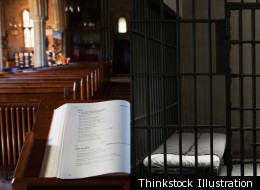 Starting this week, under a new program called Operation ROC (Restore Our Community), local judges in Bay Minette, Alabama, will give those found guilty of misdemeanors the choice of serving out their time in jail, paying a fine or attending church each Sunday for a year.
The goal of the program is to help steer those who are not yet hardened criminals the chance to turn their lives around. Those who choose to go to church (there are no mosques or synagogues in the area) will have to check in with a pastor and the police department each week, CNN affiliate WKRG reported. Once you attend church every week for a year the case would be dismissed.
Police Chief Mike Rowland said the measure is one that would help save money and help direct people down the right path. Rowland told WKRG it costs $75 a day to house each inmate.
"Longevity is the key," he told WKRG.
He said he believes 30-day drug programs don't have the long-term capabilities to heal someone in the ways the ROC program might.
Police in the town said they think it is a simple choice, but others think it's a choice that shouldn't even be offered.
The ACLU in Alabama said the idea is "blatantly unconstitutional," according to the Alabama Press-Register.
"It violates one basic tenet of the Constitution, namely that government can’t force participation in religious activity," Olivia Turner, executive director for the ACLU of Alabama told the paper.
Rowland acknowledged there were concerns about separation of church and state complaints but said he didn't see it as too big of a problem because offenders weren't being forced to attend church, they are just being given the option.
The offenders who voluntarily choose church over jail get to pick the churches they attend. If they complete a year’s attendance, Rowland said, their criminal case would be dismissed.
Source
Subscribe to:
Posts (Atom)