Showing posts with label children. Show all posts

Wednesday, March 25, 2015

Baby names on the verge of extinction

Getty
As anyone who named their son Jayden recently knows, baby names go in and out of style all the time. And newly trendy names leave old-fashioned ones in the dust.

Baby-naming site Nameberry usually ranks the most popular monikers out there, but decided in a recent blog post to focus on the dwindling names across America. They crunched the numbers from the Social Security Administration's 2013 birth records to find out the names that likely won't hit the playground anytime soon.

Once fewer than five babies get a certain name in a full year, the name is considered extinct. Nameberry found 13 names that were given to exactly five babies each back in 2013. So if you meet a little toddler named Zelma or Sheba, you can tell the little one she's even rarer than one in a million.

Here are the most endangered names out there, according to Nameberry:

Girls
• Alpha
• Barbra
• Claudine
• Nanette
• Sheba
• Sondra
• Thisbe
• Zelma

Boys
• Elmo
• Icarus
• Inigo
• Llwellyn
• Remus
• Sherwood
• Waldo

Saturday, March 14, 2015

Wednesday, March 11, 2015

Team rallies behind cheerleader with Down syndrome


One of the cheerleaders at Lincoln Middle School in Kenosha, Wisconsin, is Desiree Andrews, an eighth-grader who has Down syndrome.
Kenosha News

While performing with the Lady Knights’ Cheerleading Squad at a recent basketball game, Desiree was getting bullied from the stands. That’s when a few boys from the basketball team decided to do something about it, Kenosha News reported.


“The kids in the audience were picking on Dee, so we all stepped forward,” basketball player Chase Vazquez told TMJ4.

kenoshanews.com

The players called a timeout, walked off the court, and took action, telling the bully to stop.

“One of the kids stepped up and said, ‘Don’t mess with her,’” Brandon Morris, the boys’ seventh-grade coach the year before, told Kenosha News. “Then all of the guys got together to show her support.”

jrn.com
“It’s not fair when other people get treated wrong because we’re all the same. We’re all created the same. God made us the same way,” said player Scooter Terrien.


Now Desiree, who they call Dee, never walks to class alone.


And the gym has been affectionately renamed in her honor: They’re calling it D’s House.

Athletic Director Timothy Nieman told TMJ4 that the nickname has stuck, and he’s erecting a banner with the title.

The last home game on March 9 was even played in Desiree’s honor, with the boys chanting, “Who’s house? Dee’s house!”

“The cheerleaders and the basketball players that I’ve been working with the last two years are some of the kindest and most supportive students that I’ve ever had the pleasure of working with,” Nieman said.


The gesture wasn’t lost on Desiree. “It was sweet, kind, awesome, amazing,” she said.

Source

Tuesday, February 24, 2015

Feeding babies food with peanuts may prevent allergies

Babies at high risk for becoming allergic to peanuts are much less likely to develop the allergy if they are regularly fed foods containing the legumes starting in their first year of life.

That's according to a big new study released Monday involving hundreds of British babies. The researchers found that those who consumed the equivalent of about 4 heaping teaspoons of peanut butter each week, starting when they were between 4 and 11 months old, were about 80 percent less likely to develop a peanut allergy by their fifth birthday.

"This is certainly good news," says Gideon Lack of King's College London, who led the study. He presented the research at the annual meeting of the American Academy of Allergy, Asthma and Immunology. It was also published in The New England Journal of Medicine.

As many as 2 million U.S. children are estimated to be allergic to peanuts — an allergy that has been increasing rapidly in the United States, Britain and other countries in recent years. While most children who are allergic to peanuts only experience relatively mild symptoms, such as hives, some have life-threatening reactions that can include trouble breathing and heart problems.

"Peanut allergy can be extremely serious," Lack says.

Lack's study was launched after he noticed that Israeli kids are much less likely to have peanut allergies than are Jewish kids in Britain and the United States.

"My Israeli colleagues and friends and young parents were telling me, 'Look, we give peanuts to these children very early. Not whole peanuts, but peanut snacks,' " Lack says.

Peanut snacks called Bamba, which are made of peanut butter and corn, are wildly popular in Israel, where parents give them to their kids when they're very young. That's very different from what parents do in Britain and the United States, where fears about food allergies have prompted many parents to keep their children away from peanuts, even though the American Academy of Pediatrics revised a recommendation to do so in 2008.

"That raised the question whether early exposure would prevent these allergies" by training babies' immune systems not to overreact to peanuts, Lack says. "It's really a very fundamental change in the way we're approaching these children."

To try to find out, Lack and his colleagues got funding from the U.S. National Institutes of Health to launch a study. They found 640 babies who were at high risk for developing peanut allergies because they already had eczema or egg allergy. They asked half of the infants' parents to start feeding them Bamba, peanut butter, peanut soup or peanut in some other form before their first birthday and followed them for about five years.

"What we found was a very great reduction in the rate of peanut allergy," Lack says. About 17 percent of the kids who avoided peanuts developed peanut allergies, compared with only 3.2 percent of the kids who ate peanuts, the researchers reported.

Based on the findings, Lack thinks most parents should start feeding their babies peanut products as early as possible — not whole peanuts or globs of peanut butter, but peanut mixed in some other food to avoid any possible choking hazard.

"We've moved, really, 180 degrees from complete avoidance to we should give peanuts to young children actively," Lack says.

Other allergy experts hailed the results as an important advance.

"This is a major study — really what we would call a landmark study," says Scott Sicherer, who advises the American Academy of Pediatrics on allergies. "There's been a huge question about why there's an increase in peanut allergy and what we can do to try to stem that increase. And this is a study that directly addresses that issue."

But Sicherer says we have to be careful, since some kids are really sensitive to peanuts.

"If you're a parent sitting at home with your child looking at them saying, 'Well, gee, they didn't eat peanut yet. Maybe I should run to the cupboard and get some peanut butter for them,' it could be a little bit dangerous because if you do that and the child has a bad allergic reaction, you would be at home and have a problem," Sicherer says.

So Sicherer says parents who have some reason to think their kids might be allergic to peanuts should get them tested first and then only try feeding them peanuts with a doctor in the room.

But other specialists say for most parents, the new findings should encourage them to start feeding their kids peanuts as early as possible.

"This is a question we get asked constantly in our clinic. When parents come in, they often have young children. They want to know what should they do. This really provides us with the answer," says Hugh Sampson, who heads the Jaffe Food Allergy Institute at Mount Sinai in New York. Sampson co-authored an editorial being published with the study.

"So now I think we're on firm ground, and we can go forward and look the parents in the eye and say, 'This is something that will be beneficial,' " Sampson says.

A key question is whether kids will have to keep eating peanuts to keep any allergy at bay. Lack is following the kids in his study to find out what happened to them after they stopped eating peanuts regularly.
Wednesday, April 16, 2014

The facebook baby invasion might be a figment of your imagination

Getty Images
Last year, I experienced a Facebook trauma that made me question if I could ever trust my News Feed again. There I was, scrolling away and minding my own business, when the photo of a sonogram popped up: “The arrow is pointing at baby’s scrotum/peepee!!” the caption exalted. “That’s our boy!!! Mommy and Daddy love you soooo much!!!!” For some reason, I hadn’t registered that this would be my News Feed’s natural progression after all of those engagement ring, “OMG I SAID YES, NOW CHECK OUT THIS ROCK!,” photo shoots. And like that, I started seeing baby Facebook photos everywhere.

Or maybe, like many other Internety 20-somethings, I was just being melodramatic. Because according to a piece on Wired,which enlisted the help of Microsoft Research computer scientist Meredith Ringel Morris, there really aren’t that many baby photos out there.
After a child is born, Morris discovered, new mothers post less than half as often. When they do post, fewer than 30 percent of the updates mention the baby by name early on, plummeting to not quite 10 percent by the end of the first year. Photos grow as a chunk of all postings, sure—but since new moms are so much less active on Facebook, it hardly matters.
New moms undershare. I’m probably more likely to see someone taking a selfie with Crab Cakes Eggs Benedict than their progeny. But I am probably less prone to be shocked by bacon and eggs than I am by a peer entering the parenthood stage of life.

Morris said that another reason why baby photos might seem to show up more frequently could be because they get a disproportionate amount of likes and, thus, get promoted on feeds. I’ll admit, I panicked and liked the “Peepee” shot… I’m part of the problem!

So what it all comes down to is, we all need to chill out and stop whining about the baby pictures. Even though some people definitely do overshare—a Twitter employee recently live tweeted her own labor—it’s not that big of a deal.

Wednesday, March 26, 2014

Mumps are back thanks to anti-vaxxers

During my studies for the pediatric board exams, I learned a lot about diseases I never expected to encounter. Some were incredibly rare. Others were isolated to corners of the globe where I never intended to practice. And some had been so well-controlled by vaccines that it no longer seemed like I would ever actually see a case during my career.

Perhaps it is naive, but I still hope that expectation holds true. I hope I never actually see a case of tetanus. I hope epiglottitis remains something I know how to recognize but never come across. And I certainly hope the geopolitical catastrophe of a single case of smallpox is something nobody ever lives to witness.

Until recently, measles would have been on my list of “theoretical but not actual” clinical considerations. Given the success of the MMR vaccine in eliminating the disease from the United States, I assumed I could file “Koplik spots” in the back of my brain alongside the signs of scurvy.

And then came the measles outbreaks. Last year there were eleven outbreaks, and 2014 isn’t shaping up any better. Given that—thanks to low vaccine rates—measles is now endemic in the United Kingdom, another outbreak is only a plane ride away when the destination is a vulnerable community.

One of the more infuriating complaints vaccine-refusers make about immunizations is that they’re not 100% effective, so why administer them to your children? Leaving aside the grossly unrealistic belief that any medical intervention is 100% effective for all recipients, this question indicates a deep misunderstanding of “herd immunity.” (It’s ironic that vaccine-deniers understand herd immunity so poorly, as it’s what they rely on to keep their own children free of disease.) Since no vaccine creates perfect immunity in everyone who receives it (which any competent medical provider will readily admit), it’s necessary for a certain percentage of the population to be vaccinated to protect the population as a whole. If enough people are protected, when a contagion enters the community it won’t spread even if not everyone who received the vaccine responded appropriately.
“Why a person would choose to avoid a safe vaccine against a disease that kills infants without warning remains an open question.”

With measles already back, what else could we expect if vaccination rates fall below levels necessary to prevent outbreaks?

Mumps
Like measles, mumps is another vaccine-preventable illness that’s already back in the news. In fact, there’s an outbreak at The Ohio State University right now.

Mumps is a viral infection. The hallmark of the disease is painful swelling of the parotid glands (which are the salivary glands on either side of the cheeks), often accompanied by fever and malaise. Swelling can involve one or both glands. Other symptoms can include painful inflammation of the testicles, breasts, and ovaries. Rarely, severe infections can lead to inflammation of the brain or meningitis.

As with almost all vaccine-preventable illnesses, mumps used to be very common, but had a precipitous drop in infections with licensure of the first vaccine. It is currently administered as one of the components of the MMR vaccine (along with measles and rubella). Like some pertussis outbreaks, the clusters of new mumps cases that occur every few years (usually on college campuses) can’t be pinned entirely on vaccine-refusers. Reports from the Ohio outbreak indicate that most of those affected had received at least one mumps vaccine (though complete protection requires two shots), which shows that vaccines aren’t always 100% effective.

However, if we don’t want to go from “occasional, contained outbreak” to “common childhood illness” all over again, it’s important that all children be fully vaccinated to confer as much protection to public health as possible.

Pertussis

We may as well begin with another preventable illness that’s already coming back. Pertussis, or “whooping cough,” is caused by the bacterium Bordetella pertussis.It starts with symptoms that look a lot like a common cold, which then turn into weeks of uncontrollable coughing. The cough can be so bad it cracks ribs.

Awful as those symptoms may be, other outcomes of infection can be even worse. In infants under 12 months, the only symptom of the disease can be apnea—babies infected with pertussis can simply stop breathing as the first and only sign they’ve been infected.

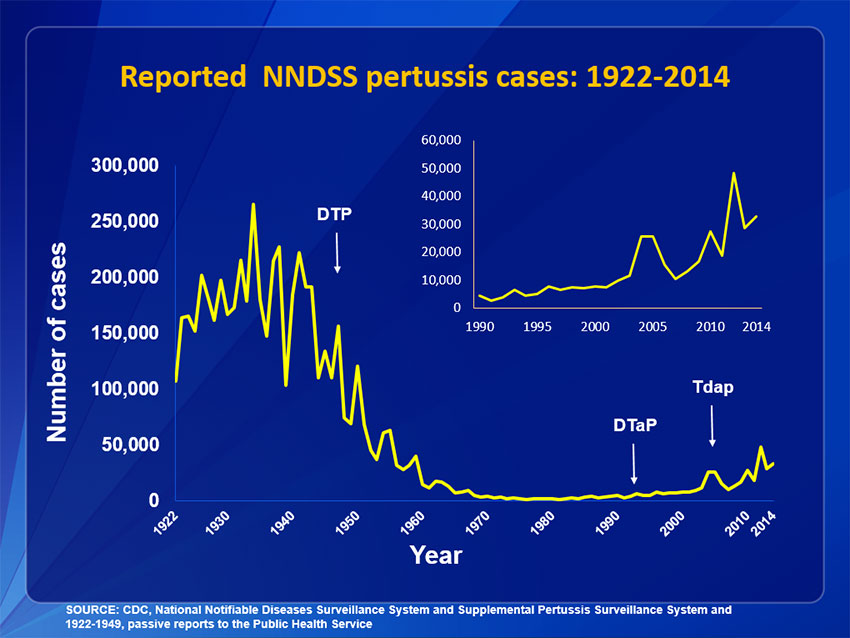
With the advent of the first pertussis vaccine, rates of the disease dropped dramatically. However, unlike measles, it has never been considered eradicated within the United States. Over the past few years, the usual cyclic trend of new cases has been spiking higher and higher.

In the case of pertussis, the blame for increasing incidence of new infections may not be entirely the fault of vaccine-deniers. During the 1990s, the vaccine against whooping cough was changed to lower the risk of side effects like fever, and the newer vaccine may not confer immunity that is as broad or lasting. With that said, there is clear evidence that communities with a high rate of vaccine refusal are more likely to experience an outbreak.

Of course, why a person would choose to avoid a safe vaccine against a disease that kills infants without warning remains an open question.