I'm moving in a few months, so I need to get rid of some clothes! Check out my poshmark closet (as well as my favorite closets) below.
Showing posts with label fashion. Show all posts
Showing posts with label fashion. Show all posts
Sunday, April 5, 2015


Thursday, March 12, 2015
2015: Spring Wishlist

1) Target - Women's Bernice Taper Toe Two Piece Flats
2) Forever 21 - Boucle Knit Cardigan
3) Triangl - Milly Swimsuit
4) J. Crew Factory - Racerback Cami
5) Amazon - Fashion Vintage Round Thick Horn Style Sunglasses
6) H&M - Top with Butterfly Sleeves
7) Topshop - Scallop Frill Tee
8) Jessica Simpson - Jadyn Wedge
9) Claire V - Supreme Haircalf Fold Over Clutch
Tuesday, February 17, 2015
My winter 2015 purchases

Monday, February 2, 2015
Thursday, January 22, 2015
My 2015 winter purchases

1) Sheinside - Black & white coat
2) Forever21 - Turtleneck poncho sweater
3) Nordstrom - Faux fur infinity scarf
4) Frye - Jane Boot in Redwood
5) Forever21 - Mesh-Trimmed Skater Dress
6) Banana Republic - Seamed Inset Tank
7) Forever21 - Heathered Metallic Bodycon Dress
Wednesday, January 7, 2015
C. Wonder to shut down completely
 |
| C. Wonder |
The company called an internal town hall meeting at 11 a.m. today, where its roughly 100 employees were told the brand would be shutting down, said a person at the meeting who declined to be identified citing a lack of authorization to speak publicly. Today was the last day for all but a handful of employees who will stay on to help C. Wonder close down, said two people familiar with the matter. The meeting lasted 15 minutes or less; most of the Flatiron office emptied out by 1 p.m., the first source said.
C. Wonder’s 11 U.S. stores, already pared down from a massive round of closings in recent months, will shutter completely in the next two to three weeks, while its website is slated to shut down by the end of next week, the person at the meeting said. They added that Chris Burch, who recently relocated his office from the Flatiron office to Miami, was not present at the meeting. C. Wonder has also abruptlyshut down its social media accounts on Twitter, Facebook, Instagram, and Pinterest.
Daniela Maron, a spokeswoman for C. Wonder, didn’t immediately respond to a voicemail and email seeking comment.
Venture capitalist J. Christopher Burch opened the first C. Wonder in 2011. The brand, which sells a variety of home goods, jewelry, and knick-knacks, drew immediate comparisons to his ex-wife Tory Burch’s more expensive namesake brand. Some in the industry dubbed C. Wonder an act of “revenge retail,” a mentality that may have pushed the chain into a number of ill-advised, costly leases. The company, for example, spent a couple of years opening an expensive Flatiron store in Manhattan; internally, it’s believed that Chris chose that spot because a hair salon favored by Tory Burch is upstairs.
BuzzFeed News reported in November that C. Wonder planned to close up to 20 of its 32 stores by Jan. 1, depending on how lease negotiations unfolded, and transition into a wholesale brand. Unnamed sources at Burch Creative Capital told WWD at the time that the report was “off-base,” and that the brand would “continue to run freestanding stores.”
The company has 11 U.S. stores listed on its website, excluding a seasonal Nantucket location, and was slated to call them at noon today to inform them of the closures, the person at the meeting said. It also has three international stores and has been in the process of expanding into the Philippines.
Harlan Kent, C. Wonder’s CEO of less than a year, told employees at the town hall meeting that the company tried many tactics to turn itself around in the past six months, from closing stores to cutting staff, but that it wasn’t enough, the person said. He went on to say the board of directors made the decision to close the entire business.
Employees weren’t completely shocked, given recent 75%-off discounts on merchandise and the closures, the person said. Suspicions were also raised after it appeared as though new tenants were scoping out the office and following Chris Burch’s office move, they said.
Sources told BuzzFeed News in November that Chris Burch has distanced himself from C. Wonder in the past year, focusing on other investments instead. He’s been working on a new line with Ellen DeGeneres called E.D. and spending a lot of time in Indonesia, two sources say, where he and a friend acquired a resort called Nihiwatu on the island of Sumba.
Monday, December 22, 2014
Winter purchases

1. Target - Oversized Plaid Scarf (Identical to the sold out one at Zara)
2. Zara - Fitted Down Jacket With Furry Collar
3. J. Crew Factory - Quilted Puffer Vest (Sold out online but is restocked from time to time. I also bought mine in store, which was fully stocked with them)
4. J. Crew Factory - Factory Crystal Domes Necklace
5. Rampage - Jaycer Boots (Via TJ Maxx)
6. J. Crew Factory - Class Button-Down Shirt in Gingham
8. J. Crew Factory - Knit Tweed Dress
Friday, December 12, 2014
Clothing items women should buy from the men's department
 |
| BuzzFeed/Via hm.com |
First thing’s first: Men’s clothes are usually made better than women’s clothes.
Why? Affordable clothing brands usually have an allotted amount of money to spend on menswear and womenswear. Menswear will usually involve fewer clothing templates (or patterns) because they offer fewer style options. For womenswear, however, manufacturers use TONS of templates (for crop tops, boat necks, oversize tees, blouses, tank tops — and we’re only talking about shirts here!). Since the templates can get expensive, there may be less money left over in the budget to invest in materials.
Exhibit A: Boyfriend jeans versus your boyfriend’s actual jeans.
Your boyfriend is paying less — so why shouldn’t you? “If you get a smaller size in a skinny fit, men’s jeans can feel more comfortable and even cost less than boyfriend styles,” says Sara Qaddoura, curator of e-commerce at London-based fashion startup Not Just A Label. Plus, menswear offers a whole new range of sizes for your fine bod.
Cool? Cool. So here’s how to beat the system and buy up the men’s department…
Looking for a new sweater? Buy it in men’s.
“Chunky menswear knits tend to be cheaper than those found in the women’s department,” says Qaddoura. “And sometimes they’re even made from better material.”
Button-up for one? Get it in men’s.
Men’s shirts have more structure, which can give you a cool, boxy look, according to Sonny Oram, founder of Boston-based style blog Qwear. Button them up to the top or throw one on over a dress (the length can work in your favor). Roll up the sleeves and you’ve got this!
Baggy sweatpants or low-slung jeans, perhaps? Men’s all the way.
“I look for pants that hang on the hip and get them hemmed,” says Qwear fashion director Shiona Heru.
Could use a cute backpack or weekender, huh? Check out men’s.
Since backpacks are a central accessory in menswear, check out the other side of the store before you settle on a clutch (no handles, say wha?!).
Dying for a comfy tee? Shop in men’s.
Wear a white men’s tee with jeans or buy one a few sizes bigger to wear as a shirt dress, according to Qaddoura.
Oversize jacket, ya? Totes in the men’s department.
The world of oversize is your oyster in the men’s department. Jackets, blazers, sweaters, sweatpants: All of it can look cool and comfy.
Thick socks? Calling to you from menswear.
If you have a larger shoe size, this benefit is yours to reap. Thick, chunky knit socks are common fare in the men’s department — and they look cute with winter outfits like underwear and tea-stained robes.
Source
Friday, May 16, 2014
Do consumers really know what they are getting from outlet stores?
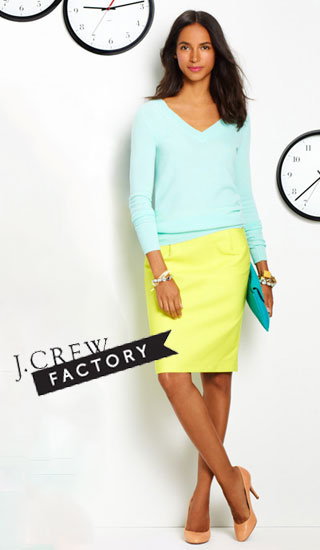
Once a destination for out-of-season or damaged full-priced inventory, outlets have grown into a lucrative and somewhat deceptive place for retailers to hawk an entirely new line of lower-quality goods geared toward a different customer. J.Crew, like many other retailers, notes in filings that it sells “a specific line of merchandise” through J.Crew Factory that’s “based on (full-price) products sold in previous seasons” — in other words, it’s kind of a knockoff of itself.
J.Crew and competitors like Gap and Off 5th, Saks’ outlet brand, have learned they can generate larger profit margins by selling cheaper, made-for-factory products, and so they are increasingly stocking outlets with such goods. But it’s spurred a heated debate in the industry over whether consumers are really aware of what they’re buying. Despite increased coverage of the issue in recent years, discussions abound online about how to tell outlet merchandise apart from the “real” stuff, an easier task with some brands than others. J.Crew Factory, for example, puts two diamonds under the “r” on its labels, while the Gap Outlet label uses three dots.
But it’s not always so visible. Executives from Off 5th, which carries brands like True Religion and Alice + Olivia, told investors last year its products are 10% leftover Saks inventory, 25% private-label goods, and the rest mostly merchandise created for the stores by “brand-appropriate” vendors. While price tags on outlet goods may list a manufacturer-suggested retail price (known as an MSRP) or, a “valued at” price, that’s little more than a number ascribed by the retailer and doesn’t mean it was ever sold for such a sum in an actual full-price retail location. (Giant discounters likeT.J. Maxx and Nordstrom Rack also label prices this way.)
When there are authentic items in the mix, it’s not easy to tell because there aren’t any rules around that from the Federal Trade Commission. On Off 5th’s website, a Rag & Bone knit dress is listed at $122.99, a 62% discount from the original price of $325. But when you hover over the price, it brings up a box that says: “The strikethrough price reflects the regular price at which we’ve normally sold that item or, if we have not previously sold an item, the price at which that item (or a comparable item) is normally sold in the market.” So, there’s a chance any of these items could be cheaper versions of the real thing, sent straight from the designer labels to outlets.
Retailers’ embrace of e-commerce for its outlet stores — once purposefully located many miles away from full-price stores — is giving consumers a new and powerful tool to compare and contrast such items. J.Crew’s factory website, launched in late 2012 with the tagline “It’s your stylish little secret,” makes side-by-side comparisons of similar merchandise possible for the first time. Gap and Banana Republic outlets also plan to test online by the end of this fiscal year, a spokeswoman said.
E-commerce represents “the change in the marketplace — the customer can compare without regard to geography what’s being made available to them, and that’s why expansion of these outlet strategies is very, very dangerous,” said Mark Cohen, a professor of marketing at Columbia Business School. “At what point does your outlet business become too visible to your regular business?”
Four members of Congress went so far as to ask the FTC in January to investigate “potentially misleading marketing practices by outlet stores,” citing the difficulty in identifying made-for-outlet goods and “deceptive reference pricing.” They also noted there is no standardized definition for “factory outlet” and “outlet store,” both largely interchangeable terms.
Connecticut’s Better Business Bureau also recently posted an article explaining to consumers that looking at factory goods versus full-price items might be an “apples to oranges” comparison, suggesting there’s confusion around what the merchandise actually is.
“There’s no regulation that defines use of the word ‘outlet’ — it’s wide open as an opportunity,” Cohen said.
This dress may never have been sold at $325.
The New York Times magazine noted as far back as 1997 that many outlet goods were made-for-factory. But brands have been increasing that proportion steadily in recent years, according to calls with analysts and investors — it’s so much more profitable to take “make” out of a product then sell it at a supposedly discounted price than to sell actual full-priced, high-quality goods at a discount.
In the past year, Bebe has said it believes it can sustain outlets with 65% made-for-outlet merchandise, while American Eagle has said it anticipates carrying 75% made-for-factory items starting this year. Under Armour said in September that its outlets have recently carried 75% made-for-outlet goods, while Children’s Place said its proportion is closer to 80%. Coach and high-end luggage maker Tumi have said 85% of their outlet goods are made-for-factory. Vera Bradley said it plans to carry more made-for-factory items because it has learned it’s downright problematic to carry retired designs “right on the heels” of selling them at full price. But adding to the confusion, you have some brands at the other end of the spectrum, like Lululemon, which carries only genuine excess inventory in its outlet stores, and Abercrombie, which only recently started testing two outlet stores with made-for-factory product.
It seems to be a lucrative business, especially in a deeply competitive retail environment. J.Crew stopped breaking out sales from J.Crew Factory years ago, but said in a 2005 filing that its outlets produced $447 in sales per gross square foot, just shy of the $462 for full-price stores.
Michael Kercheval, president and CEO of International Council of Shopping Centers, the industry’s largest trade group, contends that consumers “fully understand” that they’re typically not getting authentic brand leftovers at outlets.
“It has been a transition where going to the outlet was a little bit of an adventure, you didn’t know what you were going to find,” he said. “That doesn’t happen now. People go to the outlets knowing that if it’s an Eddie Bauer outlet, it’s Eddie Bauer outlet products. There may be full-price there, but most of the merchandise is going to be made for outlets … Quite frankly, if you get a pair of sunglasses from the outlet store that is a name brand, you will know there’s a reason why it cost one-fourth of what you would pay at a full-price store.”
Kervechal says the difference between outlet merchandise and non-outlet merchandise has become so distinct that regional malls may even open separate wings of factory stores in coming years. The availability of outlet goods online has actually made it clear the customer doesn’t care that the two are different, he says.
But Cohen, the Columbia professor, thinks retailers should be careful about how they operate their outlet businesses versus their main ones, especially as the web increases transparency.
“The folks that do this carefully will be fine, and the folks that will be careless and stupid are going to get hurt,” he said.
Source
Thursday, March 20, 2014
New company allows bridesmaids to rent their dress

“Many of my best friends aren’t engaged yet, so I have many more to come,” she says. “It’s an honor, but it’s an expensive honor.”
So the 28-year-old recent UCLA business school grad decided to do something about it.
Her new company, Vow to be Chic, rents designer dresses for bridesmaids from a website. Instead of paying hundreds of dollars for a new dress, customers pay $95 to $125 and, after the bride and groom head off into the sunset, the dresses go back.
Exclusive deals
The site has struck exclusive deals to carry several of the most popular styles each from five of the eight top designers of bridesmaid dresses, including Swoon and Lula Kate. Every dress is available in multiple colors and a full range of sizes.
Traditionally, a bride selects the dress for her bridesmaids, who then each must head to one particular boutique for a fitting. It’s often stressful as well as expensive – think of Katherine Heigl’s character in the movie “27 dresses.”
The average designer dress costs about $300, generating $2 billion annually amidst the overall $50 billion spent on weddings in the United States.
Vow to be Chic starts by helping a bride select a dress for her bridesmaids online. Then the renting bridesmaids send in their measurements and, way before the wedding, get the dress in two sizes to try on. Once the fit is confirmed, the sizing dresses go back to Vow to Be Chic, which sends final models out just before the nuptials.
The notion of renting fancy womens' wear has already been proven, thanks to the success of sites such as Rent the Runway, where Doorey worked before business school. During college, she also interned with a wedding planner in New York City and saw firsthand just how much stress arose from the bridesmaid dress-fitting process.
"Not okay with men outsmarting women"
“It dawned on me one day that men had been renting tuxedoes for decades,” she says. “I’m not okay with men outsmarting women in the fashion arena.”
The business plan comes amidst a boom for the so-called sharing economy, whether it's cheaper car rides from Uber, cheaper vacation rentals from AirBnb or cheaper vacuums from SnapGoods. It’s all fitting with the current post-boom, shallow recovery economic climate.
But it still wasn’t easy for Doorey to get all the designers on board. While many retailers sell bridesmaid dresses online, no one was renting high-end, designer styles. “I’m not sure about this Internet thing,” Doorey recalls one designer telling her.
Doorey was planning to head back East after graduating from UCLA’s Anderson School of Management last year. Then she and friend Anna Baxter won the school’s annual new-venture competition and a $15,000 prize to turn the idea of Vow to be Chic into a reality. Several of the judges, professional venture capitalists, offered to invest more on the spot.
One of those backers, Matt McCall of the Pritzker Group, says he generally doesn’t fund e-commerce startups like Vow to be chic. “I dislike that space – I hated that going into the contest,” he says. “But I ended up so impressed with Kelsey.”
Along with her prior experience and exhaustive market research, Doorey's calm, CEO-like demeanor under pressure helped convince the investors to come aboard. The site has been available to a limited, private audience since last year and opens to the public in a few weeks. She also has plans to expand into related areas as the business grows. Brides come to the site more than eight months before their wedding to sign up, creating a potentially lucrative market for other wedding vendors.
That’s all a ways down the road, however. For now, Vow to be Chic will stick to bridesmaids rentals and, hopefully, prevent anyone from having to become another 27-dress hoarder.
Saturday, March 15, 2014
Clothing brand uses models with PhDs
 |
| Betabrand |
“When you look beyond the ranks of the professionally beautiful, photography becomes a lot more fun,” Betabrand founder Chris Lindland said in a statement, according to AdWeek. “Our designers cooked up a collection of smart fashions for spring, so why not display them on the bodies of women with really big brains?”
On the one hand, the promotion is an empowering statement, especially for STEM advocates, considering most of the models have or are pursuing PhDs in science and engineering. On the other hand, the women all have the same thin body type and are beautiful by conventional standards, so is it really a revolutionary campaign?
Tuesday, February 18, 2014
Sneaky ways retailers get you to spend more
1. Supersized Carts

The trick: Just as goldfish expand to fill the container they’re in, it turns out the amount of groceries we buy is directly related to the dimensions of our cart—with a bigger one enticing us to spend up to 37% more. Watch out for that mini-cart your mini-me is pushing, too: “You might think, ‘Wow, this store is really kid-friendly,’” says Lindstrom. “Well, retailers are turning up kid-friendly elements because, on average, a consumer will spend 30% more when they have kids with them.” Retailers even place desirable products at children’s eye level, so they’ll beg you. “And it works,” he says.
The solution: Opt for a basket or smaller cart (or be OK with leaving a mammoth one half-full), and, if possible, shop alone. Even having a spouse along can hurt you: Seven out of ten people spend more time shopping when with a partner.
2. Nostalgic Music
The trick: It turns out Christmas music is a perennial hit for marketers. “It’s an old trick—it makes us feel nostalgic, like we’re children again,” says Lindstrom, who calls the phenomenon “rosy remembering.” In other words, it takes us back to life in simpler times. As a result, we tend to spend 17% more than when generic music is playing. But sound, in general, is a powerful motivator. Increasingly, stores are creating what Lindstrom calls “soundscapes”: The butcher department might play the sound of sizzling steak, or in the soft drink aisle, you’ll hear soda fizzing on ice. “It’s a way to activate an emotion we’re not aware of,” he says, “which stimulates us to buy.”
The solution: Bring your own soundtrack: “Wear your iPod and listen to upbeat music,” says Lindstrom. “It may sound crazy, but it not only will make you shop faster, it will also save you money.”
3. The Denomination Effect
The trick: Stop for a sec and imagine the cashier carefully counting out single bills as she gives you change. Did you know there’s a strategic reason stores do so? It’s called the Denomination Effect—or the fact that we’re much more likely to spend $100 if it’s broken down into smaller bills than if we’re carrying around a C-note. In fact, a 2009 study showed that breaking a $100 bill to make a purchase is 48% harder than spending exactly the same amount using smaller notes. That’s why we don’t mind spending spare change on gum or magazines at the cash register, but won’t necessarily break a $20 to do so: We tell ourselves that we’re spending less when only forking over singles.
The solution: “Test yourself,” advises Lindstrom. “Try carrying a $100 bill and see how long it takes you to break it. And resist checkout temptation, which adds up.”
4. The Rise of Vani-sizing
The trick: Maybe you’ve fallen prey to this at some point: “But these pants are a size 4, and they fit me!” Cue your triumphant march to the register. Vani-sizing—when stores make clothes bigger so we think we can fit into a smaller size—is “in nearly every store out there,” says Lindstrom, and works on both men and women. Take, for example, the fact that in three different stores, a pair of men’s pants with a 36-inch waist was found to actually measure anywhere from 37 (at H&M) to 39 (at the Gap) to 41 (at Old Navy.) Why it works: Our purchase decisions are one part logic and at least one part emotion. Advertisers play on feelings like size envy to motivate us to buy.
The solution: Remember, nobody’s ever going to see that tag. You’ll save more if you size up only how well a given piece fits—and disregard its number.
5. Mirror Manipulation
The trick: It turns out your dressing room mirror may not always reflect reality. “Playing with light is a huge one,” says Lindstrom. Many stores—as anyone who’s ever spent any time in a Victoria’s Secret knows—will add a slight tint of rosy color to their fitting room mirrors to make us look fresher and more tanned. In fact, a recent experiment showed we actually spend 19% more if we think we look better in the looking glass. We may even unwittingly be getting an in-store makeover: Mirrors at the front are typically untampered with, with flattering lighting happening only when you’re ready to try on the wares.
The solution: Make sure to study potential purchases on the store floor, not just in an idealized environment created to sway you.
6. Shopping Speed Bumps
The trick: “Most stores study the way we walk around and grab products, then design themselves around the concept,” says Lindstrom. Now retailers are even installing what the industry calls “speed bumps” into the floor. ”Subconsciously, when we feel those little bumps, we will slow down and look around rather than navigate our shopping cart,” he says. On average, the bumps create a 15-second delay, which, in a supermarket study, led to as much as 17% in additional spending as shoppers contemplated additional purchases.
The solution: Beating this comes down to being alert: You know each time you hit a speed bump on the road. Now that you’re aware they can exist indoors too, remember why they’re there—and that it has little to do with a speed limit.
7. Not-so-Free Samples
The trick: You’re cruising along with your cart, intent on getting laundry detergent and toilet paper—when suddenly you hear, “Can I offer you a sample?” Out of nowhere an employee extends a toothpick-speared bite of the latest pizza bagel. “Reject it,” says Lindstrom. “Whenever you grab a sample, you tell your body it’s dinner time, and your brain will tune into the topic of food.” In fact, 40% of people who accept an in-store sample will begin buying food, he says, even though they never planned to do so in the first place.
The solution: Just say no, of course. But the easiest way to resist this form of temptation is to avoid shopping on an empty stomach.
8. Built-In Interruptions
The trick: “You’re in Wal-Mart, when all of a sudden a display of canned corn the size of a small house blocks your path,” says Lindstrom, “and you can’t help but notice, ‘Hey, this is only $1.50.’” Guess what? That canned pyramid wasn’t built for aesthetic reasons. Whether it’s an in-store obstruction trumpeting a deal, or merely your cell phone ringing, the latest science proves that whenever we’re interrupted, we lose our focus and become more likely to spend. Specifically, when we abandon our shopping list to consider a deal a store presents us with, or revisit an item we were looking at before the phone rang, we’re 35% more likely to close the deal—and willing to spend up to 15% more for the very same product.
The solution: “Turn your cell phone off,” says Lindstrom, “and leave your shopping list at home.” While that latter point might seem counterintuitive, stores, he says, have gotten wise to our to-do lists—arranging products that would make more sense next to each other far apart for the express purpose of exposing us to more costly interruptors.
9. The Credit Card “Discount”
The trick: “Would you like to receive 15% of your purchase today?” the saleswoman trills, offering an application for the store’s credit card. At LearnVest, we’ve told you many times that opening an in-store card was a bad idea, but “millions of women still fall for it,” says Lindstrom. Here’s why what seems like a good offer actually works against you: again, the unexpected interruption. You were ready to pay, had your card out, and her offer catches you off guard. “That’s when they go in for the kill,” says Lindstrom. “You think: ‘Well, why not? What’s the harm?’ The harm is major.” First, that salesperson isn’t just being nice—she gets a bonus if you sign up. Research also shows that with that card in hand, you spend an average of 30% more. Plus, the store will now know all of your buying habits. “It’s a practice so deceptive,” says Lindstrom, “some members of Congress think this should be regulated.”
The solution: At LearnVest, we do believe in discounts—but not ones that will bite you back. If shopping online, look for coupon codes or open a separate email address just for deals, and invite stores you like to send you special offers there.
Source
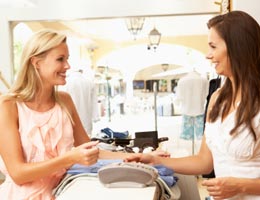
The trick: Just as goldfish expand to fill the container they’re in, it turns out the amount of groceries we buy is directly related to the dimensions of our cart—with a bigger one enticing us to spend up to 37% more. Watch out for that mini-cart your mini-me is pushing, too: “You might think, ‘Wow, this store is really kid-friendly,’” says Lindstrom. “Well, retailers are turning up kid-friendly elements because, on average, a consumer will spend 30% more when they have kids with them.” Retailers even place desirable products at children’s eye level, so they’ll beg you. “And it works,” he says.
The solution: Opt for a basket or smaller cart (or be OK with leaving a mammoth one half-full), and, if possible, shop alone. Even having a spouse along can hurt you: Seven out of ten people spend more time shopping when with a partner.
2. Nostalgic Music
The trick: It turns out Christmas music is a perennial hit for marketers. “It’s an old trick—it makes us feel nostalgic, like we’re children again,” says Lindstrom, who calls the phenomenon “rosy remembering.” In other words, it takes us back to life in simpler times. As a result, we tend to spend 17% more than when generic music is playing. But sound, in general, is a powerful motivator. Increasingly, stores are creating what Lindstrom calls “soundscapes”: The butcher department might play the sound of sizzling steak, or in the soft drink aisle, you’ll hear soda fizzing on ice. “It’s a way to activate an emotion we’re not aware of,” he says, “which stimulates us to buy.”
The solution: Bring your own soundtrack: “Wear your iPod and listen to upbeat music,” says Lindstrom. “It may sound crazy, but it not only will make you shop faster, it will also save you money.”
3. The Denomination Effect
The trick: Stop for a sec and imagine the cashier carefully counting out single bills as she gives you change. Did you know there’s a strategic reason stores do so? It’s called the Denomination Effect—or the fact that we’re much more likely to spend $100 if it’s broken down into smaller bills than if we’re carrying around a C-note. In fact, a 2009 study showed that breaking a $100 bill to make a purchase is 48% harder than spending exactly the same amount using smaller notes. That’s why we don’t mind spending spare change on gum or magazines at the cash register, but won’t necessarily break a $20 to do so: We tell ourselves that we’re spending less when only forking over singles.
The solution: “Test yourself,” advises Lindstrom. “Try carrying a $100 bill and see how long it takes you to break it. And resist checkout temptation, which adds up.”
4. The Rise of Vani-sizing
The trick: Maybe you’ve fallen prey to this at some point: “But these pants are a size 4, and they fit me!” Cue your triumphant march to the register. Vani-sizing—when stores make clothes bigger so we think we can fit into a smaller size—is “in nearly every store out there,” says Lindstrom, and works on both men and women. Take, for example, the fact that in three different stores, a pair of men’s pants with a 36-inch waist was found to actually measure anywhere from 37 (at H&M) to 39 (at the Gap) to 41 (at Old Navy.) Why it works: Our purchase decisions are one part logic and at least one part emotion. Advertisers play on feelings like size envy to motivate us to buy.
The solution: Remember, nobody’s ever going to see that tag. You’ll save more if you size up only how well a given piece fits—and disregard its number.
5. Mirror Manipulation
The trick: It turns out your dressing room mirror may not always reflect reality. “Playing with light is a huge one,” says Lindstrom. Many stores—as anyone who’s ever spent any time in a Victoria’s Secret knows—will add a slight tint of rosy color to their fitting room mirrors to make us look fresher and more tanned. In fact, a recent experiment showed we actually spend 19% more if we think we look better in the looking glass. We may even unwittingly be getting an in-store makeover: Mirrors at the front are typically untampered with, with flattering lighting happening only when you’re ready to try on the wares.
The solution: Make sure to study potential purchases on the store floor, not just in an idealized environment created to sway you.
6. Shopping Speed Bumps
The trick: “Most stores study the way we walk around and grab products, then design themselves around the concept,” says Lindstrom. Now retailers are even installing what the industry calls “speed bumps” into the floor. ”Subconsciously, when we feel those little bumps, we will slow down and look around rather than navigate our shopping cart,” he says. On average, the bumps create a 15-second delay, which, in a supermarket study, led to as much as 17% in additional spending as shoppers contemplated additional purchases.
The solution: Beating this comes down to being alert: You know each time you hit a speed bump on the road. Now that you’re aware they can exist indoors too, remember why they’re there—and that it has little to do with a speed limit.
7. Not-so-Free Samples
The trick: You’re cruising along with your cart, intent on getting laundry detergent and toilet paper—when suddenly you hear, “Can I offer you a sample?” Out of nowhere an employee extends a toothpick-speared bite of the latest pizza bagel. “Reject it,” says Lindstrom. “Whenever you grab a sample, you tell your body it’s dinner time, and your brain will tune into the topic of food.” In fact, 40% of people who accept an in-store sample will begin buying food, he says, even though they never planned to do so in the first place.
The solution: Just say no, of course. But the easiest way to resist this form of temptation is to avoid shopping on an empty stomach.
8. Built-In Interruptions
The trick: “You’re in Wal-Mart, when all of a sudden a display of canned corn the size of a small house blocks your path,” says Lindstrom, “and you can’t help but notice, ‘Hey, this is only $1.50.’” Guess what? That canned pyramid wasn’t built for aesthetic reasons. Whether it’s an in-store obstruction trumpeting a deal, or merely your cell phone ringing, the latest science proves that whenever we’re interrupted, we lose our focus and become more likely to spend. Specifically, when we abandon our shopping list to consider a deal a store presents us with, or revisit an item we were looking at before the phone rang, we’re 35% more likely to close the deal—and willing to spend up to 15% more for the very same product.
The solution: “Turn your cell phone off,” says Lindstrom, “and leave your shopping list at home.” While that latter point might seem counterintuitive, stores, he says, have gotten wise to our to-do lists—arranging products that would make more sense next to each other far apart for the express purpose of exposing us to more costly interruptors.
9. The Credit Card “Discount”
The trick: “Would you like to receive 15% of your purchase today?” the saleswoman trills, offering an application for the store’s credit card. At LearnVest, we’ve told you many times that opening an in-store card was a bad idea, but “millions of women still fall for it,” says Lindstrom. Here’s why what seems like a good offer actually works against you: again, the unexpected interruption. You were ready to pay, had your card out, and her offer catches you off guard. “That’s when they go in for the kill,” says Lindstrom. “You think: ‘Well, why not? What’s the harm?’ The harm is major.” First, that salesperson isn’t just being nice—she gets a bonus if you sign up. Research also shows that with that card in hand, you spend an average of 30% more. Plus, the store will now know all of your buying habits. “It’s a practice so deceptive,” says Lindstrom, “some members of Congress think this should be regulated.”
The solution: At LearnVest, we do believe in discounts—but not ones that will bite you back. If shopping online, look for coupon codes or open a separate email address just for deals, and invite stores you like to send you special offers there.
Source
Sunday, February 9, 2014
Retailers ask: where did teenagers go?
 |
| Brian Thomas/NYT |
When 19-year-old Tsarina Merrin thinks of a typical shopper at some of the national chains, she doesn’t think of herself, her friends or even contemporaries.
“When I think of who is shopping at Abercrombie,” she said, “I think it’s more of people’s parents shopping for them.”
Sales are down across the shelves of many traditional teenage apparel retailers, and some analysts and others suggest that it’s not just a tired fashion sense causing the slump. The competition for teenage dollars, at a time of high unemployment within that age group, spans from more stores to shop in to more tempting technology.
And sometimes phones loaded with apps or a game box trump the latest in jeans.
Mainstays in the industry like Abercrombie & Fitch, American Eagle Outfitters and Aéropostale, which dominated teenage closets for years, have been among those hit hard.
The grim reports of the last holiday season have already proved punishing for senior executives at the helm of a few retailers. In a move that caught many analysts by surprise, the chief executive of American Eagle, Robert L. Hanson, announced he was leaving the company last week. And on Tuesday, Abercrombie announced they were making several changes to the company’s board and leadership, including separating the role of chief executive and chairman.
Aside from those shake-ups, analysts are saying they do not expect much improvement in this retail sector any time soon.
According to a survey of analysts conducted by Thomson Reuters, sales at teenage apparel retailers open for more than a year, like Wet Seal, Zumiez, Abercrombie and American Eagle, are expected to be 6.4 percent lower in the fourth quarter over the previous period. That is worse than any other retail category.
“It’s enough to make you think the teen is going to be walking around naked,” said John D. Morris, an analyst at BMO Capital Markets. “What happened to them?”
Paul Lejuez, an analyst at Wells Fargo, said he and his team put out a note in May on the health of the teenage sector and department stores called “Watch Out for the Kid With the Cough.” (Aéropostale was the coughing teenager.) Nonetheless, he said, “We ended up being surprised just how bad things got so quickly. There’s really no sign of life anywhere among the traditional players.”
Causes are ticked off easily. Mentioned often is the high teenage unemployment rate, reaching 20.2 percent among 16- to 19-year-olds, far above the national rate of 6.7 percent.
Cheap fashion has also driven a more competitive market. So-called fast-fashion companies, like Forever 21 and H&M, which sell trendy clothes at low prices, have muscled into the space, while some department stores and discount retailers like T. J. Maxx now cater to teenagers, as well.
“You can buy a plaid shirt at Abercrombie that’s like $70,” said Daniela Donayre, 17, standing in a Topshop in Manhattan. “Or I can go to Forever 21 and buy the same shirt for $20.”
Online shopping, which has been roiling the industry for years, may play an especially pronounced role in the teenage sector, analysts say. A study of a group of teenagers released in the fall by Piper Jaffray found that more than three-fourths of young men and women said they shopped online.
Not only did teenagers grow up on the Internet, but it has shaped and accelerated fashion cycles. Things take off quickly and fade even faster, watched by teenagers who are especially sensitive to the slightest shift in the winds of a trend.
Matthew McClintock, an analyst at Barclays, pointed to Justin Bieber as an example.
“Today, if you saw that Justin Bieber got arrested drag-racing,” Mr. McClintock said, “and you saw in the picture that he had on a cool red shirt, then you can go online and find that cool red shirt and have it delivered to you in two days from some boutique in Los Angeles.
“Ten years ago, teens were dependent on going to Abercrombie & Fitch and buying from the select items that Mike Jeffries, the C.E.O., thought would be popular nine months ago.”
Just last week, Mr. Bieber’s mug shot from his arrest showed him in a red jail-like top.
And this week, Mr. Jeffries lost one of his titles, chairman, which he held since 1996. He will continue on the board as a director and as the company’s chief executive.
In other shuffling, Abercrombie announced that the chief financial officer, Jonathan E. Ramsden, would become the chief operating officer, which is a new position at the company.
The announcement about Mr. Jeffries along with the elimination of the company’s shareholder rights plan — which is designed to prevent potential buyers from acquiring too much control of the company — was greeted favorably by the stock market when it was announced.
Earlier, Brian P. Logan, Abercrombie’s vice president for finance, released a statement in response to questions about the company’s health and the sector’s difficulties. In the statement, Mr. Logan said Abercrombie was “pleased” with its holiday performance, during which sales fell 6 percent over the previous year, because the company expected it to be worse.
Another factor chipping away at teenage retailers may be the shifting priorities among young people. Where clothing was once the key to signaling a teenager’s identity, other items may have become more important and now compete for their dollars.
“Probably the most important thing a teenage boy has is his smartphone,” said Richard Jaffe, an analyst at Stifel Nicolaus. “Second, is probably his sneakers. Third, maybe, we get to his jeans.”
What may trump all of those, Mr. Jaffe said, are gaming systems, especially over the last few months, because Xbox and PlayStation both released new game consoles in 2013. That may have taken a bite out of what teenagers had to spend on clothes.
But analysts also point to other broad factors, like still limited discretionary spending on the part of some parents, or too many store locations.
More immediately, it could be an issue of fashion. Last year was also a year that came and went without any must-have trends that might have helped nudge teenagers toward the mall, as brightly colored pants did in the previous years.
Many companies have had their own unique mix of challenges. The Urban Outfitters brand, for example, which focuses on teenagers more than the company’s other stores, Free People and Anthropologie, blamed a 1 percent dip in third-quarter sales on fashion misses.
At Abercrombie, analysts say, part of their problem is almost the opposite — that they do not focus on fashion enough, and what is on the racks does not substantially change.
“I was a fan, in middle school,” said Ava Tunnicliffe, 20. “I feel like style has moved on, and Abercrombie hasn’t.”
Friday, January 31, 2014
Google hopes that designer frames will make Glass less dorky
 |
Google is adding prescription frames and new styles of detachable sunglasses to its computerized, Internet-connected goggles known as Glass.
The move comes as Google Inc. prepares to make Glass available to the general population later this year. Currently, Glass is available only to the tens of thousands of people who are testing and creating apps for it.
Glass hasn't actually had glasses in its frame until now.
Glass is basically a small computer, with a camera and a display screen above the wearer's right eye. The device sits roughly at eyebrow level, higher than where eyeglasses would go.
It lets wearers surf the Web, ask for directions and take photos or videos. Akin to wearing a smartphone without having to hold it in your hands, Glass also lets people read their email, share photos on Twitter and Facebook, translate phrases while traveling or partake in video chats. Glass follows some basic voice commands, spoken after the words "OK, Glass."
The gadget itself is not changing with this announcement. Rather, Google plans to make various attachments available for people who wear glasses or sunglasses. Starting Tuesday, the Mountain View, Calif., company is offering four styles of prescription frames and two new types of shades available to its "explorers" — the people who are trying out Glass. The frames will cost $225 and the shades, $150. That's on top of the $1,500 price of Glass.
Users can take the frames to any vision care provider for prescription lenses. Google says it is working with insurance provider Vision Service Plan to train eye-care providers around the U.S. on how to work with Glass.
Google says some insurance plans may cover the cost of the frames. VSP, which covers 64 million people in the U.S., will also provide coverage for the frames and prescription lenses as part of its partnership with Google.
Isabelle Olsson, the lead designer for Google Glass, says the new frames open the spectacles up to a larger audience.
She demonstrated the new frames to The Associated Press last week at the Google Glass Basecamp, an airy loft on the eighth floor of New York City's Chelsea Market. It's one of the places where Glass users go to pick up their wares and learn how to use them. Walking in, visitors are greeted, of course, by a receptionist wearing Google Glass.
"We want as many people as possible to wear it," she said.
To that end, Glass's designers picked four basic but distinct frame styles. On one end is a chunky "bold" style that stands out. On the other is a "thin" design — to blend in as much as possible.
Olsson said Google won't be able to compete with the thousands of styles offered at typical eyeglasses stores. Instead, Glass's designers looked at what types of glasses are most popular, what people wear the most and, importantly, what they look good in.
The latter has been a constant challenge for the nascent wearable technology industry, especially for something like Google Glass, designed to be worn on your face. When Google unveiled Glass in a video nearly two years ago, it drew unfavorable comparisons to Bluetooth headsets, the trademarks of the fashion-ignorant technophile.
In designing Google Glass, Olsson and her team focused on three design principles with the goal of creating something that people want to wear. These were lightness, simplicity and scalability. That last one means having different options available for different people — just as there are different styles of headphones, from in-ear buds to huge aviator-style monstrosities.
Google Glass currently comes in five colors — "charcoal," a lighter shade of gray called "shale," white, tangerine and bright blue "sky." The frame attachments out Tuesday are all titanium. Users can mix and match.
"People need to be able to choose," Olsson said. "These products need to be lifestyle products."
Thursday, January 23, 2014

Sunday, January 5, 2014
Where do the clothes at discount stores come from?

Not all overstock merchandise is sloppy seconds. Overstock happens when department stores overestimate the demand for an item. Sometimes merchandise is unusual: say, a pair of pleather, cheetah-print overalls. It might also be irregular, with flaws ranging from a tag sewn upside-down or two pant legs with different inseams. Much of the clothing at Ross Dress for Less is irregular overstock from lower-end department stores, like JCPenney. Even if it's irregular, overstock merchandise is usually current or from last season, not years old. Department stores start selling next season's clothing early, hence those comical swimsuit displays in the middle of winter. So manufacturers often buy back merchandise from department stores and sell it to off-price retailers all within the same season.
T.J. Maxx, whose parent company also owns Marshalls and HomeGoods, is the biggest off-price retailer in North America. It claims that 85 percent of its merchandise is from the current season and less than 5 percent is irregular. Instead of solely buying overstock merchandise after department stores can't sell it, T.J. Maxx often buys from brands and designers at the same time as stores like Macy's. Department stores make a few big orders and buy in an array of sizes and colors, but T.J. Maxx buys new merchandise every week and can buy it piecemeal. So the same in-season, designer items can be found at higher-end department stores and T.J. Maxx at the same time, only the latter sells them for up to 60 percent off. (And no, T.J. Maxx is not sponsoring this post.)
T.J. Maxx can offer discounts because it's getting a better deal up front. It all goes back to the buy-back clause. Once T.J. Maxx—or any off-price retailer—buys merchandise, it's responsible for selling it. Items that don't sell at one off-price location might be sent to another store, or put on clearance. If they still don't sell, they're eventually donated to a thrift store.
Moral of the story: Don't pay full-price for those pleather, cheetah-print overalls.
Wednesday, October 23, 2013
eBay listings
I'm selling two pairs of shoes on eBay! Check them out:
Corso Como knee-high leather boots

Steve Madden pink/coral snakeskin flats

Corso Como knee-high leather boots

Steve Madden pink/coral snakeskin flats
6Q~~60_12.JPG)
Tuesday, October 22, 2013
Christian Louboutin redefines the "nude" heel
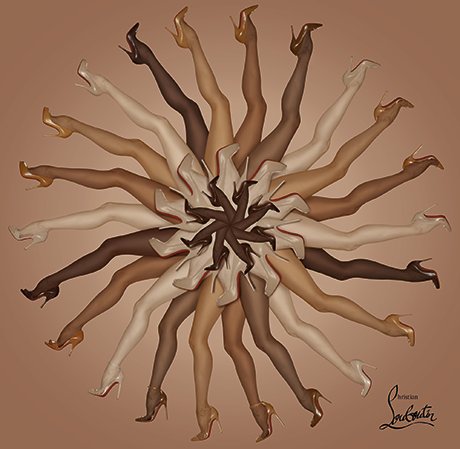 In fashion, "nude" can be used to describe the color of anything from Kate Middleton's favourite pumps to a blouse or a shade of nail polish. The color in question is a sort of beige, biscuity shade, roughly similar to the color of Caucasian skin. It is praised for its flattering qualities and, when it comes to shoes, its leg-lengthening powers.
People with skin of any other color – and, therefore, women from ethnic minorities – are implicitly unable to participate in this trend. If a pair of "nude" pumps blends with the color of a white woman's skin, the same pair will contrast against black skin. As with plasters, children's dolls and – still – foundation, white skin remains the default option.
Christian Louboutin – more associated with red soles and the highest of heels than race relations – is making attempts to change that. His Nudes collection is designed to match a range of skin tones – from the familiar traditional "nude" to a rich dark brown, with five different styles available. The campaign images show off the idea with lots of legs of various races, and an app even matches the shade of your own skin to the shoes for you.
Smaller brands may have dipped a toe in this debate, but for one of the biggest names in footwear to jump in is to be applauded. It's a no-brainer, though – commercially as much as anything else. Whatever you think about the style, it's smart to offer the leg-lengthening trick to many more of the female population – you'll sell more shoes. With prices around the £400-and-up mark, Louboutin's collection isn't, of course, going to make an impact on the vast majority, but the ripples sent to the high street no doubt will. In the meantime, "nude" remains a word that should be used with caution.
Source
Tuesday, October 15, 2013




Monday, September 30, 2013
Ten solutions to your most annoying shoe problems
 Shoes that feel as cozy as slippers in the store can become just the opposite after an evening out or a couple weeks of wear. And few stores allow customers to return worn shoes. The shoe's material and construction could be the problem, or it could be fit. "Sizes in even the most expensive shoes don't accommodate individual lengths and widths of feet," says Linda O'Keefe, author of Shoes: A Celebration of Pumps, Sandals, Slippers and More. Rather than burying the pair in the back of your closet, check out these 10 fixes for the most common is shoes.
1. Too Tight Straps
While many leather straps stretch with wear, you can shorten the breaking-in process with water. H2O can gently stretch leather, molding it to the shape of your foot, says Meghan Cleary, author of Shoe Are You? Before you wear shoes out the first time, spritz them with "a light spray of plain water," she says. "Wear them around until dry."
2. Blisters
These are most likely to crop up on the bottoms of feet because of friction between your feet's soles and the shoe's. To avoid blisters, line each shoe with moleskin foam, which creates a cushion. The padding absorbs friction with a layer of cotton over the foam. "Adhere it to the inside of each shoe before the first time you wear them," suggests Cleary.
Dr. Scholl's Molefoam Padding, $28.46 for an 8-pack; Amazon.com
3. Arch Pain
Shoes that cause this likely don't provide enough support in the middle of your foot. Stick to brands known for supportive kicks, including Cole Haan, Clarks and Onex, suggests Kimberly Ade, a stylist at Keri Blair Image Experts in Denver. Or at the very least, "opt for wedges instead of skinny heels," she says. Wedges distribute weight away from the ball of your foot and more evenly throughout the shoe. And when you wear heels, choose ones that are shorter than three inches, adds Ade. But if most shoes make your arches ache, orthotics, custom-fitted shoe inserts from a podiatrist, may help…for a price. They can set you back $800.
4. Sweaty Feet
Too-small shoes can heat up your tootsies and cause blisters. To get a better fit, "only buy shoes at the end of the day when your feet may be swollen and tired," suggests O'Keefe. Even if the shoe fits, the material may turn up the temperature. Save patent leather and rubber for colder times of year, and opt for breathable canvas and natural leather in warmer weather. And if you're wearing socks, choose cotton ones, rather than those with artificial fabrics, to absorb sweat. One more trick:Cleary recommends sprinkling baby or shoe deodorizing powder in shoes before wearing them to soak up moisture while they're on your feet.
5. Cuts on the Back of Your Heels
Shoes that dig into your skin can be some of the most painful to wear. While you may think they're too snug, the problem is more likely that they're too big. Overly spacious shoes let feet shift around and are the biggest reason for cuts, says Ade. Consider taping heel pads into the back of your shoes. The cushion "prevents your heel from moving in and out of the shoe and skin from getting cut," Ade explains.
Foot Petals Heavenly Heelz, $6.95 for a pair; FootPetals.com
6. Calluses
The hard, dead skin that can form on the soles of feet and the sides of big toes can be tough to get rid of. But prevention starts with choosing well-fitting shoes. "Avoid jamming your foot into a shoe that's too small or narrow," says Cleary. Another good idea: Wear socks or tights in shoes, which can thwart unwanted friction. "If you already have calluses, soak, pumice and moisturize your feetoften." Or use a foot file to slough them off.
Diamancel Diamond File for Foot Calluses, $38; Sephora.com
7. Heels Sinking into Grass
Attending a dressy outdoor wedding? Rethink the stilettos. Many types of heels sink into the ground and even thick carpet, making maneuvering tricky and dancing next to impossible. If you must wear skinny heels, tack on a heel cap that adds surface area to the bottom of your heel, lowering your chances of getting stuck in the ground. Otherwise, stick to wedges, which elongate legs like heels do, but are more comfortable outdoors.
Solemates High Heelers, $19.90 for two pairs; Solemates.com
8. Scuffed Leather
A single visible scratch can make nice, new shoes look like old, poorly made ones. While there's no way to completely avoid scratching leather shoes, polishing shoes you wear often can help, saysAde. "The more you polish, the less likely scratches are to form," she explains. For best results, once a month, wash the shoe before polishing; then, use a cream-based polish and buff with a soft cloth. Keep in mind that patent leather is more prone to deep scratching, Ade adds.
9. Wobbly Heels
You're walking around when BAM-your heel detaches from the sole. How embarrassing. Not all shoes have a sturdy metal shank that connects the inner sole to the heel. So before you buy, walk around the store to make sure the heels aren't wobbling. Ade says chunkier heels are better bets. Whatever shoes you purchase, "don't rock back and forth in them; that'll weaken the attachment," Ade points out. If heels do detach, a cobbler can reattach them for about $20-which may or may not be worth it depending on the original shoe cost.
10. Soles Wearing Off
Dressier shoes' soles can quickly become scuffed from hitting the street, resulting in tattered-looking footwear. Try sole protectors, which make soles extra-durable and slip-resistant. "Addingrubber soles to the bottom of shoes or heel taps can extend the life of the soles and heels," Clearyexplains. Ask a cobbler to add rubber soles; the service runs anywhere from $15 to $30.
Subscribe to:
Posts (Atom)