Showing posts with label doctor who. Show all posts
Showing posts with label doctor who. Show all posts
Wednesday, December 25, 2013

Tuesday, December 10, 2013
The top 10 Doctor Who episodes for history buffs
“Doctor Who,” the classic British sci-fi television show, celebrates its 50th anniversary this weekend. For those who’ve never seen the program, which in the United States has aired mostly on PBS stations and, more recently, BBCAmerica, here’s a short rundown: The main character is a man called the Doctor. He’s an alien from a race called the Time Lords. He travels through time and space in a blue police box that’s really a disguise for his bigger-on-the-inside ship called the TARDIS (Time and Relative Dimension in Space). In each episode, the Doctor and a companion (or two or three) explore the universe while fighting monsters and other enemies along the way. And every so often, the doctor “regenerates,” taking on a new body and face, letting a new actor take over the lead role.
The formula has changed little since “Doctor Who” first premiered on BBC on November 23, 1963. The show has survived poor production values, the Doctor getting stranded on Earth for years, declining public interest in the show, cancellation in the late 1980s, as well as a failed attempt to reboot the series in 1996 only to come back in 2005, gaining new fans and new respect.
“Doctor Who” has been distinct from other members of the science fiction genre, such as “Star Trek,” which focused solely on the future, by taking advantage of the ability to travel through time and periodically visiting the past. This focus on history has waxed and waned over the years, reflecting the interests and wants of the show’s producers and viewers, but it produced some unique storylines centered on pivotal moments in human history. Nearly all of these episodes are available on DVD or Netflix, although two of the episodes from the Crusades are preserved only as audio.
“The Aztecs” (1964)
Adventures in the first season of “Doctor Who” took viewers into historical events such as Marco Polo’s 1289 expedition to Central Asia and the Reign of Terror in late 18th-century France. Though the show’s most iconic monsters, the pepperpot-shaped Daleks, had already been introduced by this time, these history stories got their drama from human events. In “The Aztecs,” the Doctor (William Hartnell) and his companions become trapped in 15th-century Mexico. One of the companions, history teacher Barbara, is briefly hailed as a divine reincarnation of a high priest and tries to put an end to the Aztec practice of human sacrifice. Her efforts fail, and history moves on.
“The Crusade” (1965)

“Doctor Who” has frequently celebrated and explored iconic periods in British history while putting a bit of twist on them. In “The Crusade,” the Doctor (again played by William Hartnell) and his companions find themselves in 12th-century Palestine, caught in the middle of the conflict between the European crusaders, led by King Richard the Lionheart, who have conquered the land and the Saracens, led by Saladin, who are trying to kick them out. The story highlights the political machinations of the real-life leaders and the bloodthirsty nature of the Crusades themselves. The Doctor tries not to get caught up in court politics, as Richard attempts to broker a peace agreement by marrying off his sister to Saladin’s brother. But of course the Doctor fails, barely escaping a death sentence.
“Pyramids of Mars” (1975)

The Doctor may be known for traveling through time and space, but his third incarnation (played by Jon Pertwee) was banished by his fellow Time Lords to present-day Earth. Time travel stories returned, however, with the Fourth Doctor (portrayed by Tom Baker). In 1975, he and his frequent companion, journalist Sarah Jane Smith, found themselves in England in 1911 in the home of a professor who had gone missing while excavating a pyramid in Egypt. The professor had accidently released an alien named Sutekh—which fans of Egyptian history will recognize as another name for the chaos god Set—who had been locked in that pyramid by his brother Horus and their fellow Osirians. The Doctor and Sarah Jane must battle robotic mummies roaming the grounds before taking down Sutekh and saving the human race.
“The King’s Demons” (1983)

One of the Doctor’s greatest enemies was another Time Lord, the Master. In The King’s Demons, the Doctor (now played by Peter Davison) encounters his arch-nemesis at a medieval joust in the time of King John. In one of the Master’s smaller evil machinations—in later years, for example, the Master turns every human on Earth into a copy of himself—he tries to thwart the course of human history by provoking a rebellion that will depose King John and prevent the creation of the Magna Carta, the foundation of constitutional government in the English-speaking world. The Doctor intervenes, setting history back on course.
“The Mark of the Rani” (1985)
The Master is messing with earthlings again, this time paired with another renegade Time Lord, the Rani, in the English town of Killingworth. This is the time of the Luddites, a group of English textile workers who were protesting changes brought about by the Industrial Revolution in the early 1800s. Key to the Doctor Who story is real-life engineer and inventor of the steam locomotive engine George Stephenson, who saves the Doctor (portrayed by Colin Baker) from a group of Luddites who pushed him down a mineshaft.
“The Empty Child/The Doctor Dances” (2005)
History episodes became more frequent with the 2005 reboot of the “Doctor Who” franchise. The show’s producers, in their efforts to reintroduce the Doctor (played by Christopher Eccleston) to a new generation, set the entire first season on Earth. In a memorable pair of episodes, the Doctor and companion Rose find themselves in London during World War II, pursued by a creepy gas-mask-wearing child with a deadly touch. While later WWII-themed episodes feature notable historical figures from that era, including Winston Churchill and Adolf Hitler, these episodes instead center on the sad story of homeless, orphaned children who had been cast adrift amidst the chaos of the London Blitz.
“The Girl in the Fireplace” (2006)

The Girl in the Fireplace is a masterful marriage of futuristic science fiction with a real person from the past. The Doctor (portrayed by David Tennant) and his companions find themselves on an abandoned spaceship in the 51st century. The crew is missing, but throughout the ship are portals into 18th-century France, points in time along the life of a Frenchwoman named Reinette. The young girl grows up to become Madame de Pompadour, mistress of King Louis XV, pursued her whole life by the clockwork men of the spaceship who believe that only her brain can fix their ship.
A classic “Doctor Who” trope is to take an event in history and provide another explanation for what happened. In this case, it’s “volcano day” in the city of Pompeii. Shortly after his arrival, the Doctor (again, David Tennant) is temporarily stranded when a merchant sells his TARDIS to a local businessman, Lucius Caecilius, who thinks the blue box is a piece of avant-garde art. Caecilius was based on a real person, Lucius Caecilius Iucundus, a banker whose villa was found in excavations of the Italian town that was buried under volcanic ash in 79 A.D. In the Doctor Who version of Iucundus’ story, the explosion that likely killed him was caused not by a volcano but by the Doctor. He and his companion Donna initiate the explosion to save the world from a race of aliens, the Pyrovillians, who were living in Vesuvius and planning to take over the Earth.
“The Unicorn and the Wasp” (2008)

The renewal of “Doctor Who” brought a new type of history episode based on literary figures. The first explained how Charles Dickens got inspired to write about ghosts at Christmas. A later story showed what happened to William Shakespeare’s missing play Love’s Labour’s Won. The third of this genre, The Unicorn and the Wasp, cleared up a mystery regarding the world’s greatest mystery writer, Agatha Christie—what happened to her during the 11 days in 1926 that she simply disappeared? In the Doctor Who story, set at a house party during the 1920s, Christie was helping the Doctor (David Tennant) solve a Christie-inspired murder mystery and then did a little traveling in the TARDIS.
“Vincent and the Doctor” (2010)
While at a Van Gogh exhibit at the Musee d’Orsay in modern-day Paris, the Doctor (played by Matt Smith) notices a curious monster peeking out a window in Van Gogh’s The Church at Auvers and decides to investigate, quickly jumping back in time to visit the great painter in 1890. Scenes directly reference paintings such as Café Terrace at Night and Bedroom in Arles, while the story revolves around Van Gogh’s periods of exhaustion and depression, as well as his eventual suicide. The Doctor’s companion Amy Pond tries to avert Van Gogh’s tragic end by taking him to the exhibition where the episode began, where he can hear his work praised. But Amy is saddened to discover that her efforts had no effect, and Van Gogh eventually killed himself, as history remembers. As with all Doctor Who’s history stories, this one reminds the viewer that although the Doctor can’t change the past’s biggest events, he can bring a bit of joy and happiness to some of our saddest moments.
Source
The formula has changed little since “Doctor Who” first premiered on BBC on November 23, 1963. The show has survived poor production values, the Doctor getting stranded on Earth for years, declining public interest in the show, cancellation in the late 1980s, as well as a failed attempt to reboot the series in 1996 only to come back in 2005, gaining new fans and new respect.
“Doctor Who” has been distinct from other members of the science fiction genre, such as “Star Trek,” which focused solely on the future, by taking advantage of the ability to travel through time and periodically visiting the past. This focus on history has waxed and waned over the years, reflecting the interests and wants of the show’s producers and viewers, but it produced some unique storylines centered on pivotal moments in human history. Nearly all of these episodes are available on DVD or Netflix, although two of the episodes from the Crusades are preserved only as audio.
“The Aztecs” (1964)
Adventures in the first season of “Doctor Who” took viewers into historical events such as Marco Polo’s 1289 expedition to Central Asia and the Reign of Terror in late 18th-century France. Though the show’s most iconic monsters, the pepperpot-shaped Daleks, had already been introduced by this time, these history stories got their drama from human events. In “The Aztecs,” the Doctor (William Hartnell) and his companions become trapped in 15th-century Mexico. One of the companions, history teacher Barbara, is briefly hailed as a divine reincarnation of a high priest and tries to put an end to the Aztec practice of human sacrifice. Her efforts fail, and history moves on.
“The Crusade” (1965)
“Doctor Who” has frequently celebrated and explored iconic periods in British history while putting a bit of twist on them. In “The Crusade,” the Doctor (again played by William Hartnell) and his companions find themselves in 12th-century Palestine, caught in the middle of the conflict between the European crusaders, led by King Richard the Lionheart, who have conquered the land and the Saracens, led by Saladin, who are trying to kick them out. The story highlights the political machinations of the real-life leaders and the bloodthirsty nature of the Crusades themselves. The Doctor tries not to get caught up in court politics, as Richard attempts to broker a peace agreement by marrying off his sister to Saladin’s brother. But of course the Doctor fails, barely escaping a death sentence.
“Pyramids of Mars” (1975)
The Doctor may be known for traveling through time and space, but his third incarnation (played by Jon Pertwee) was banished by his fellow Time Lords to present-day Earth. Time travel stories returned, however, with the Fourth Doctor (portrayed by Tom Baker). In 1975, he and his frequent companion, journalist Sarah Jane Smith, found themselves in England in 1911 in the home of a professor who had gone missing while excavating a pyramid in Egypt. The professor had accidently released an alien named Sutekh—which fans of Egyptian history will recognize as another name for the chaos god Set—who had been locked in that pyramid by his brother Horus and their fellow Osirians. The Doctor and Sarah Jane must battle robotic mummies roaming the grounds before taking down Sutekh and saving the human race.
“The King’s Demons” (1983)
One of the Doctor’s greatest enemies was another Time Lord, the Master. In The King’s Demons, the Doctor (now played by Peter Davison) encounters his arch-nemesis at a medieval joust in the time of King John. In one of the Master’s smaller evil machinations—in later years, for example, the Master turns every human on Earth into a copy of himself—he tries to thwart the course of human history by provoking a rebellion that will depose King John and prevent the creation of the Magna Carta, the foundation of constitutional government in the English-speaking world. The Doctor intervenes, setting history back on course.
“The Mark of the Rani” (1985)
The Master is messing with earthlings again, this time paired with another renegade Time Lord, the Rani, in the English town of Killingworth. This is the time of the Luddites, a group of English textile workers who were protesting changes brought about by the Industrial Revolution in the early 1800s. Key to the Doctor Who story is real-life engineer and inventor of the steam locomotive engine George Stephenson, who saves the Doctor (portrayed by Colin Baker) from a group of Luddites who pushed him down a mineshaft.
“The Empty Child/The Doctor Dances” (2005)
“The Girl in the Fireplace” (2006)
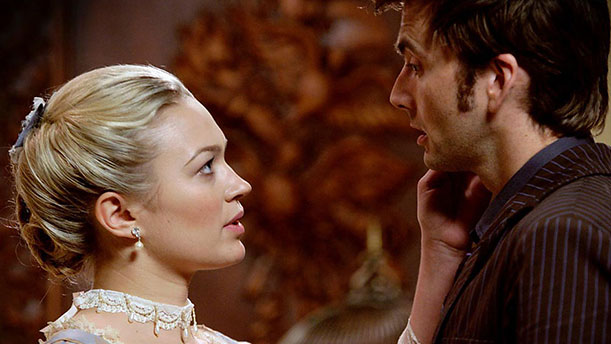
The Girl in the Fireplace is a masterful marriage of futuristic science fiction with a real person from the past. The Doctor (portrayed by David Tennant) and his companions find themselves on an abandoned spaceship in the 51st century. The crew is missing, but throughout the ship are portals into 18th-century France, points in time along the life of a Frenchwoman named Reinette. The young girl grows up to become Madame de Pompadour, mistress of King Louis XV, pursued her whole life by the clockwork men of the spaceship who believe that only her brain can fix their ship.
“The Fires of Pompeii” (2008)
“The Unicorn and the Wasp” (2008)
The renewal of “Doctor Who” brought a new type of history episode based on literary figures. The first explained how Charles Dickens got inspired to write about ghosts at Christmas. A later story showed what happened to William Shakespeare’s missing play Love’s Labour’s Won. The third of this genre, The Unicorn and the Wasp, cleared up a mystery regarding the world’s greatest mystery writer, Agatha Christie—what happened to her during the 11 days in 1926 that she simply disappeared? In the Doctor Who story, set at a house party during the 1920s, Christie was helping the Doctor (David Tennant) solve a Christie-inspired murder mystery and then did a little traveling in the TARDIS.
“Vincent and the Doctor” (2010)
While at a Van Gogh exhibit at the Musee d’Orsay in modern-day Paris, the Doctor (played by Matt Smith) notices a curious monster peeking out a window in Van Gogh’s The Church at Auvers and decides to investigate, quickly jumping back in time to visit the great painter in 1890. Scenes directly reference paintings such as Café Terrace at Night and Bedroom in Arles, while the story revolves around Van Gogh’s periods of exhaustion and depression, as well as his eventual suicide. The Doctor’s companion Amy Pond tries to avert Van Gogh’s tragic end by taking him to the exhibition where the episode began, where he can hear his work praised. But Amy is saddened to discover that her efforts had no effect, and Van Gogh eventually killed himself, as history remembers. As with all Doctor Who’s history stories, this one reminds the viewer that although the Doctor can’t change the past’s biggest events, he can bring a bit of joy and happiness to some of our saddest moments.
Source
Thursday, March 22, 2012
More information about the next Doctor Who companion
David Tennant was one of the most popular Doctors in the history of Doctor Who, so when the news broke that Karen Gillan, who plays Doctor Who's assistant Amy Pond in the current series of the show, is being replaced by Emmerdale actress Jenna-Louise Coleman, we wanted to know what David thought about it. After all, he's pretty much the expert on the subject!
We tracked down David to see what he thought about the breaking news and he was visibly excited to be talking about Doctor Who.
When we asked him if he thought Jenna-Louise, who is best-known for playing Jasmine Thomas in Emmerdale, would do a good job on the show, David replied:
"The people who make these decisions make them with great attention and love."
He then added: "The people behind the show wouldn't have chosen her unless she's the best girl for the job, so I'm excited to see her on the show."
So are we David! In fact, we can't wait for Jenna-Louise to make her Doctor Who debut in the Christmas special episode later on in the year.
Source
Thursday, November 24, 2011
Who will play the Doctor in the Doctor Who film?

THE BOOKIES' TIPS
Boring! William Hill has installed David Morrissey as 6/1 favourite, the actor having once played a Doctor-of-sorts in a 2008 Christmas special. Second favourite Chiwetel Ejiofor (7/1) would make an intriguing choice as the character has for 40-odd years been white; Rhys Ifans would be the first Welsh Doctor (20/1) and Chris Martin (33/1) the first incumbent rock star.THE DIRECTOR'S HINTS
Yates has insisted he wants the film to have a "British sensibility", so maybe he'll hire a domestic big gun. Gary Oldman was a Doctor-ishly wry and ponderous figure in Tinker Tailor Soldier Spy; Daniel Day-Lewis might do it if allowed to live for 650 years in a blue police box in preparation; Michael Sheen, meanwhile, has nailed screen roles as Brian Clough and David Frost and may be tempted to get his hands on another institutional British figure. Yates and producer Tranter worked together in 2003 on the BBC's State of Play, drama that introduced a young James McAvoy: an actor with just the right blend of innocence and knowing to pull off playing the Time Lord.THE FEMALE POTENTIAL
The Doctor has always been male, but Yates must be considering women for the role. It's time! Helen Mirren in spiky-but-soft mode (think Gosford Park or The Queen) would fit. From further afield, Bryony Hannah (stand-out player in the recent West End revival of The Children's Hour) has just the right quirky stare and indefinite manner; and former Elizabeth Bennet Jennifer Ehle has been quietly working in Hollywood for years and could bring the part some interesting heft.THE HOLLYWOOD OPTIONS
Before investing Hollywood-level dough, producers might insist on a blockbuster name. Would they dare Americanise the Doctor? A compromise might see Johnny Depp do his Special British Accent. Otherwise, Londoner Jason Statham is a proven box-office draw, even if it might be tricky to work into the plot that the Doctor is an assassin-for-hire with a murky past (it being as yet unclear whether Statham will accept other roles).Sunday, November 20, 2011
Subscribe to:
Posts (Atom)