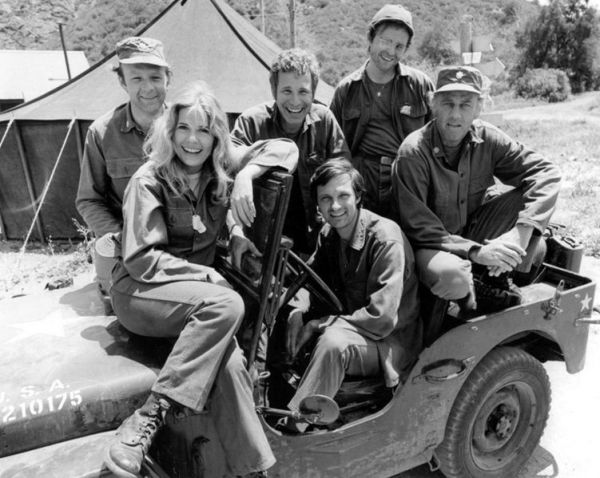
 There are plenty of TV dramas based on real people or real events, but comedy is largely more imaginative and therefore, more often fiction. Even so, you’d be surprised how many of your favorite characters and plots in sitcoms are actually based on real life people and events. Here are five such examples.
M*A*S*H
Obviously the setting of M*A*S*H is the very real Korean war, but the TV sitcom was based on a film that was, in turn based on a book by Dr. H. Richard Hornberger, a military surgeon who served in Korea. Corporal “Radar” O’Reilly was based on company clerk Don Shafer, who served beside the doctor in the war and also had the nickname “Radar.” Major Margaret "Hot Lips" Houlihan was based on two different nurses that served in Korea, Hotlips Hammerly and Janie Hall. Hammerly had a similar disposition and look as the fictional version, but Hall played a direct role in the character’s development, regularly contributing to the show with her real-life stories.
Not only were a few of the characters inspired by real people, but many of the plots used in the early seasons are based on stories the production team got from interviews with real MASH surgeons.
Community
 Greendale may seem pretty over-the-top, but it is based on Dan Harmon’s real experiences at Glendale Community College, where he got involved in a study group and began a friendship with a group of people he otherwise had nothing in common with. Harmon based Jeff on himself, acknowledging that he was self-centered and excessively independent before the group made him recognize the value of connecting with other people.
As for the delightfully bizarre Abed, he wasn’t based on a member of Harmon’s study group, but afriend
 of his who is simply obsessed with pop culture. Of course, Abed Gheith, the real life version of the character is quick to point out that he’s not quite as odd as the highly exaggerated Abed, “I think I’m a bit more aware socially. I can tell when people are uncomfortable… It seems like the one on the show has no idea that he’s around other people. Like he's watching them on TV. So he's kind of a kid-like version of me.”
Ali G
Booyakasha! Ali G, one of Sacha Baron Cohen’s many, many crazy characters is actually based on a real-life DJ. While Cohen uses the character to mock the many suburban kids who try to act like they are black, urban gangsters, the biggest source of material for the character came from Tim Westwood. Mr. Westwood is a white, middle-class son of an Anglican bishop who emulates black British culture, even speaking with a Caribbean-inspired accent. When criticized about appropriating the mannerisms of a culture he was never really a part of, Westwood replied, "Honestly, baby
, I get love out there, pure and simple."Fawlty Towers
One of the more famous examples on this list, John Cleese’s famous Fawlty Towers was based completely on a hotel the Monty Python stayed in while filming in Torquay in 1971. While staying at the Gleneagles hotel, Cleese became fascinated with the behavior of the owner, Donald Sinclair.
 At one point, Sinclair threw a bus schedule at guests when they asked when the next bus would arrive. During dinner, he mocked Terry Gilliam’s table manners because the American-born visitor switched hands while eating, which he believed to be un-British.
When Eric Idle left his briefcase off to the side while waiting for a car
to arrive, the hotel owner grabbed the briefcase and threw it behind a wall in the garden, believing it held a bomb. When they asked him about it, he explained that he had “staff problems.”Later, John Cleese described Sinclair as “the rudest man I've ever come across in my life." Of course, that didn’t stop him from staying at the hotel after filming wrapped so he could study the man in order to turn him into Basil Fawlty. Cleese later used the name “Donald Sinclair” for his character in Rat Race.
Seinfeld
 You probably already know that Seinfeld plays himself in the show, though it is a fictionalization of his real life, and that George Costanza is pretty much Larry David. If you’re a fan, you probably also know that Cosmo Kramer is based on a real-life neighbor of Larry David, comedian Kenny Kramer. You might not know that the real Kramer actually provided bus tours showing sites made famous bySeinfeld, which was then later parodied when Cosmo started offering tours touting himself as the “real J. Peterman.” Some of Kramer’s demands for the use of his name in the show are also parodied in “The Pilot” when Cosmo learns Jerry and George want to base a character on him.
Of course, these aren’t the only plots in the show that were based on the creator’s real experiences. Larry David once quit his job at SNL, regretted the decision and then returned to work, pretending nothing happened, just like George Costanza did in “The Revenge” (the difference being that it worked for David).
Even Festivus was created outside the scope of the show. Writer Dan O’Keefe conceived of the holiday as a way to handle family tension that could take place any time between December and May. His family first celebrated in February of 1966. Later, O’Keefe’s son, also named Dan, worked the holiday into “The Strike” as a December 23 alternative to Christmas.
Source

No comments:
Post a Comment