Tuesday, May 19, 2015

Shop My Closet!
I'm moving to Roanoke, VA on June 12th! I need to lessen my moving load so I'm selling tons of clothes! Check out my closet on Poshmark. I also think this is a great site for anyone looking to sell their stuff.


Friday, April 17, 2015
Gwyneth Paltrow quits the food stamp challenge after four days
 |
| What Paltrow bought with her $29 (Twitter) |
After four long days living like America’s poor, Gwyneth Paltrow broke her much-mocked attempt at shopping on a food stamp budget in search of some chicken and black licorice.
The multimillionaire mom was derided last week when she accepted the #FoodBankNYCChallenge from celebrity chef Mario Batali. The idea is to experience how difficult it is for families to live on the federal Supplemental Nutrition Assistance Program (SNAP) — better known as food stamps. So she set out with $29 — the amount the average person on food stamps receives — and every intention of showing those strapped for cash how to do it.
Less than a week later, the famished “Iron Man” actress has given up.
“As I suspected, we only made it through about four days, when I personally broke and had some chicken and fresh vegetables (and in full transparency, half a bag of black licorice),” she wrote on her blog, GOOP. “My perspective has been forever altered by how difficult it was to eat wholesome, nutritious food on that budget, even for just a few days — a challenge that 47 million Americans face every day, week, and year.”
Indeed, Paltrow’s grocery list was a little unusual given the task. She came home with a dozen eggs, some black beans and brown rice, and an array of fruits and veggies — including a baffling number of limes. Seven.
The Washington Post’s Abby Phillip said it looked like tacos in the making. Others noted the ingredients were better suited for a Paltrow detox recipe. The whole bag of food would have likely given her roughly 1,000 calories a day to work with, according to the Frisky’s Rebecca Vipond Brink.
Her noble attempt was mostly met with eye rolls.
“Don’t worry, poor people: Gwyneth Paltrow is here to show you how to GOOP your food-stamp benefits,” someone tweeted late last week.
The purpose, it seems, was really more about proving that it can’t be done. To be fair, SNAP is intended to be a supplemental program, according to the U.S. Department of Agriculture. Paltrow said the purpose of the challenge was to raise awareness and money for the Food Bank for New York City (as Batali attempts to fight against food stamp cuts.)
In the end, it gave Paltrow a reason to speak out about income equality.
“I am even more outraged that there is still not equal pay in the workplace,” she wrote. “Sorry to go on a tangent, but many hardworking mothers are being asked to do the impossible: Feed their families on a budget which can only support food businesses that provide low-quality food. The food system in our beautiful country needs to be subjected to a heavy revision — it is a cyclical problem, with repercussions that we all feel. I’m not suggesting everyone eat organic food from some high horse in the sky. I’m saying everyone should be able to afford fresh, real food. And if women were paid an equal wage, families might have more of a choice in the grocery aisles, not to mention in the rest of their lives.”
“I know hunger doesn’t always touch us all directly — but it does touch us all indirectly,” she added. “After this week, I am even more grateful I am able to provide high-quality food for my kids.”
Tuesday, April 14, 2015
Thursday, April 9, 2015
Wednesday, April 8, 2015
Tuesday, April 7, 2015
These are a few of my favorite things: Aztec Secret Indian Healing Clay
This will be a new weekly series where I discuss my favorite thing that week. It could be a television show, a beauty product, a book, etc. It will be a way for me to share what I've been loving lately.


I know what you're thinking: This has to be the most gimmicky title of all time. Aztec Secret? Really? I doubt the Aztecs were concerned with their acne. I understand that sentiment because I was thinking the same thing. However, I saw the reviews on Amazon and couldn't believe that it had a 4.5 star rating with 3,015 customer reviews. Also, several Amazon customers posted their before-and-after pictures, which completely stunned me. Some of these reviewers were even struggling with painful, cystic acne. Being the curious person that I am, I bought it Aztec Secret Indian Healing Clay.
The first time I tried the clay, I didn't listen to the reviewers who said to use apple cider vinegar instead of water. As a result? The clay was a MESS. It was very clumpy and would not combine with the water no matter so much I mixed it with my hands. Nevertheless, I slathered it on my face as best I could. I felt my face pulsating and thought "Hmmm, this must mean it's working!" I washed off the clay after about 20 minutes and then immediately moisturized my face because it felt super dry. A couple days later, I tried the clay again but used a ziplock bag to mix the clay and water. The mixture was a bit better than my first time, but still not great.
Finally, I tried it with apple cider vinegar and was blown away by how the clay just mixed with the apple cider vinegar on its own with barely any kneading from me. It felt like an actual clay mask that you buy at the drugstore. In addition, there is a plethora of people on the internet raving about the positive effect of apple cider vinegar on your face. The pulsating effect was amplified by the apple cider vinegar and my skin felt so tight that I could barely speak.
But I'm sure you're wondering if it work! It's too earlier to tell at this point but I have noticed my pores are smaller and I am breaking out less. I've also seen the small blackheads on my nose disappear. My skin is a bit sensitive after each use, so I would definitely recommend using a thick moisturizer afterward. The pulsating effect is so cool and relaxing--you feel like you've spent 20 minutes at the spa. I would definitely recommend this product to someone looking to clear up their skin and tighten their pores. Even if you don't believe me, 3,000+ people might persuade you.
There will be more Arrested Development episodes

Though it’s not official official, as in there have been no press releases officially announcing the return of Arrested Development for another season on Netflix, series producer Brian Grazer — who runs the Imagine Entertainment along with Ron Howard — told Bill Simmons in a podcast interview today that more episodes are definitely coming.
Unlike previous teases, there was no hemming or hawing about timing, or the schedules of the participants. Grazer merely stated, “We’re going to do another 17 episodes. So, stay tuned for Arrested Development.”
Timing, format, participants and other details were not disclosed. In fact, Simmons seemed to completely shrug off the announcement, steering the conversation back to another Imagine Entertainment hit, Empire (the announcement is at the 24:30 mark).
Things that twenty-something year olds need to stop wasting money on
We’re all guilty of wasting money in one way or another. Millennials? Well, unchet’s just say our generation has an extra-special knack for blowing through our hard-earned cash.
One of our biggest hurdles? That would be food. We’ve been told to eat organic, locally-sourced ingredients—none of which comes cheap. Some of this stuff is so costly (is cold-pressed juice really worth $13?) that it’s not out of the realm to wonder if we’re being taken on a wild spending ride by food marketers.
 Paying for convenience is another one of our pain points. It’s a relatively new phenomenon, thanks to the fact that all we have to do is press a button and we can have a car pick us up in three minutes, get sushi delivered in 15 minutes, or a pair of Jimmy Choos overnighted to our door.
Here, a list of 30 things twenty-somethings should think twice about before spending their money on. We aren’t saying you shouldn’t ever splurge—that’s no fun—but we are suggesting you give your spending habits a proper analysis in order to see where you could cut back that wouldn’t end up impacting your quality of living.
1. Daily lattes. Add up how much getting a fancy cup of coffee every day for 365 days is costing you and you might never be able to get out of bed again. Well, we did the math for you: Assuming your coffee is costing $5 a day, that’s a yearly spend of $1,825. Swallow that.
2. Unused gym memberships. We get it, you want to be fit, but sometimes saving money comes down to getting real with yourself. If you aren’t taking advantage of your gym membership, cancel it. You don’t need to be paying $100 a month for the idea that you could be going to the gym if you wanted to.
3. Seamless. The convenience factor of ordering takeout from basically any restaurant in your neighborhood is hard to resist (especially after a long day at work). Just like Uber, if you add up how much $20 here, and $35 there for dinner is costing you, you might just make a vow to never eat again.
4. Kale. We’ve been instructed en masse to eat superfoods like kale, goji berries, and chia seeds. Ever notice how expensive some of these foods are? We are starting to think this might be some massive conspiracy by grocery stores.
5. Credit card interest. Millenials are notorious for racking up credit card debt. Pay attention to your interest rates, and consider plans like debt consolidation, transferring your debt to another card, or simply working out a plan to pay off that debt once and for all.
Adam Katz Sinding
6. Fast fashion. You’ve probably rolled your eyes at stories told to you by your grandmother about how she bought one coat, and then wore it for the next 30 years. But that generation might have had it right. Raise your hand if you’re guilty of buying a huge quantity of clothes, and then only wearing each item a handful of times. Sometimes smart investment shopping will save you money in the long run.
7. Brand names. Do you really need brand-name cereal, brand-name toilet paper, brand-name chips, and brand-name aspirin? We didn’t think so.
8. Throwing away leftovers. Let’s also take a cue from previous generations here, and learn to make use of our food leftovers, not just throw them away.
9. Pressed juice. If you aren’t earning Harry Styles or Selena Gomez type money in your twenties, do yourself a favor and just stop drinking $12 pressed juices. You probably can’t afford it.
10. Late fees. We know, going out on your own is tough. Sometimes saving money simply means staying organized and on top of your bills to avoid late fees. Why pay extra when you don’t have to.
11. Uber. There’s nothing quite as easy as pressing a button and having a car appear to take you where you need to go. We don’t need to tell you that your Uber habit is adding up, big time. Give yourself an Uber (or taxi) cap for the month, and do your best to stick to it.
12. Eating out. This is a big one for millennials, many of which plan social activities around eating out. The best way to address this money-waster among your group of friends? Be the one to break the cycle and plan other, cheaper activities that are just as fun (pot-luck dinners, “House of Cards” binge watching sessions, you get the idea).
13. Overdraft fees. Make it a part of your routine to monitor how much money you have in your bank account to avoid overdraft fees.
14. Takeout lunch. How many days are you eating an over-priced salad for lunch during the workday? It requires a little bit of effort, but a huge money-saver is bringing your lunch to work. We know, you’ve heard this advice again and again, but think about it–you could easily end up spending $2,600 a year on salad (that’s five salads a week for 52 weeks).
15. Paying too much for smartpone data. Millenials love their smartphones. They love spending hours on Instagram, on the Internet, but we caution, watch how much money you are spending a month for your phone provider, and if you are paying overage charges for smartphone data. A quick (and beyond) easy trick to minimize these extra charges is to make sure you get on Wi-Fi wherever you can.
16. The latest tech gadgets. Is the next iPhone really going to be that different from the current one? Do you really need the latest tablet? Don’t fall under the marketing spell of rushing to buy the newest model of every gadget you own.
17. Not negotiating. Most things in life can and should be negotiated. The price of your cable package, the interest rate on your credit card, the rent increase on your apartment? Negotiate, negotiate, negotiate.
18. Overpriced cocktails. We know, that rosewater martini with liquid gold is just so damn pretty, but you don’t need to spend $25 on a drink to have a fun night out.
One of our biggest hurdles? That would be food. We’ve been told to eat organic, locally-sourced ingredients—none of which comes cheap. Some of this stuff is so costly (is cold-pressed juice really worth $13?) that it’s not out of the realm to wonder if we’re being taken on a wild spending ride by food marketers.
Here, a list of 30 things twenty-somethings should think twice about before spending their money on. We aren’t saying you shouldn’t ever splurge—that’s no fun—but we are suggesting you give your spending habits a proper analysis in order to see where you could cut back that wouldn’t end up impacting your quality of living.
1. Daily lattes. Add up how much getting a fancy cup of coffee every day for 365 days is costing you and you might never be able to get out of bed again. Well, we did the math for you: Assuming your coffee is costing $5 a day, that’s a yearly spend of $1,825. Swallow that.
2. Unused gym memberships. We get it, you want to be fit, but sometimes saving money comes down to getting real with yourself. If you aren’t taking advantage of your gym membership, cancel it. You don’t need to be paying $100 a month for the idea that you could be going to the gym if you wanted to.
3. Seamless. The convenience factor of ordering takeout from basically any restaurant in your neighborhood is hard to resist (especially after a long day at work). Just like Uber, if you add up how much $20 here, and $35 there for dinner is costing you, you might just make a vow to never eat again.
4. Kale. We’ve been instructed en masse to eat superfoods like kale, goji berries, and chia seeds. Ever notice how expensive some of these foods are? We are starting to think this might be some massive conspiracy by grocery stores.
5. Credit card interest. Millenials are notorious for racking up credit card debt. Pay attention to your interest rates, and consider plans like debt consolidation, transferring your debt to another card, or simply working out a plan to pay off that debt once and for all.
Adam Katz Sinding
6. Fast fashion. You’ve probably rolled your eyes at stories told to you by your grandmother about how she bought one coat, and then wore it for the next 30 years. But that generation might have had it right. Raise your hand if you’re guilty of buying a huge quantity of clothes, and then only wearing each item a handful of times. Sometimes smart investment shopping will save you money in the long run.
7. Brand names. Do you really need brand-name cereal, brand-name toilet paper, brand-name chips, and brand-name aspirin? We didn’t think so.
8. Throwing away leftovers. Let’s also take a cue from previous generations here, and learn to make use of our food leftovers, not just throw them away.
9. Pressed juice. If you aren’t earning Harry Styles or Selena Gomez type money in your twenties, do yourself a favor and just stop drinking $12 pressed juices. You probably can’t afford it.
10. Late fees. We know, going out on your own is tough. Sometimes saving money simply means staying organized and on top of your bills to avoid late fees. Why pay extra when you don’t have to.
11. Uber. There’s nothing quite as easy as pressing a button and having a car appear to take you where you need to go. We don’t need to tell you that your Uber habit is adding up, big time. Give yourself an Uber (or taxi) cap for the month, and do your best to stick to it.
12. Eating out. This is a big one for millennials, many of which plan social activities around eating out. The best way to address this money-waster among your group of friends? Be the one to break the cycle and plan other, cheaper activities that are just as fun (pot-luck dinners, “House of Cards” binge watching sessions, you get the idea).
13. Overdraft fees. Make it a part of your routine to monitor how much money you have in your bank account to avoid overdraft fees.
14. Takeout lunch. How many days are you eating an over-priced salad for lunch during the workday? It requires a little bit of effort, but a huge money-saver is bringing your lunch to work. We know, you’ve heard this advice again and again, but think about it–you could easily end up spending $2,600 a year on salad (that’s five salads a week for 52 weeks).
15. Paying too much for smartpone data. Millenials love their smartphones. They love spending hours on Instagram, on the Internet, but we caution, watch how much money you are spending a month for your phone provider, and if you are paying overage charges for smartphone data. A quick (and beyond) easy trick to minimize these extra charges is to make sure you get on Wi-Fi wherever you can.
16. The latest tech gadgets. Is the next iPhone really going to be that different from the current one? Do you really need the latest tablet? Don’t fall under the marketing spell of rushing to buy the newest model of every gadget you own.
17. Not negotiating. Most things in life can and should be negotiated. The price of your cable package, the interest rate on your credit card, the rent increase on your apartment? Negotiate, negotiate, negotiate.
18. Overpriced cocktails. We know, that rosewater martini with liquid gold is just so damn pretty, but you don’t need to spend $25 on a drink to have a fun night out.
Monday, April 6, 2015
ABC may be bringing back "The Muppet Show"
 |
| Fredrick M. Brown/Getty Images |
ABC is considering the new Muppets show, and THR suggests that they might announce a decision as soon as next month. The Muppets’ variety television show originally ran from 1976 to 1981, followed by its reprisal, Muppets Tonight, from 1996 to 1998. After the success of the recently rebooted Muppets movies, I can’t imagine anyone saying anything bad about this news. (Well, except for you, Statler and Waldorf.)
Sunday, April 5, 2015
Spring cleaning
I'm moving in a few months, so I need to get rid of some clothes! Check out my poshmark closet (as well as my favorite closets) below.
Thursday, April 2, 2015
Wednesday, April 1, 2015
Google maps easter egg sets pac man loose on the streets
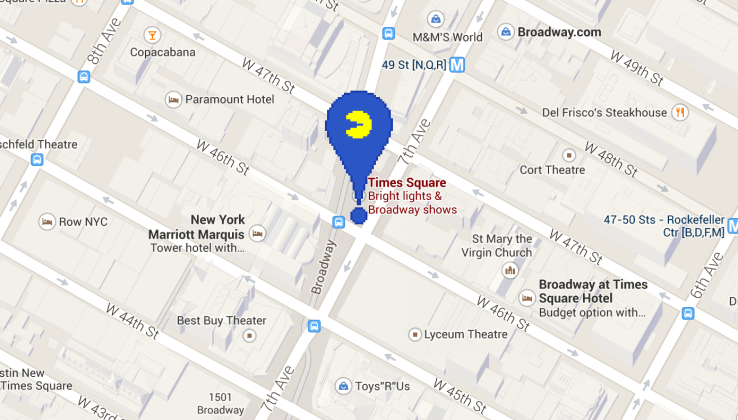
Google has created a new Easter Egg for Google Maps (pretty much just in time for actual Easter) which lets you play Pac-Man in real-world locales on the company’s Maps apps for desktop and mobie devices. It’s easy to play, by either navigating to the Google Maps website or opening the app on your Android or iOS device, and then just searching for a location where Pac-Man might show up.
Google is offering hints to help you find the iconic 1980s video game protagonist, but if you’re in a hurry just search for “times square” and you should see a pixelated map flag icon like the one pictured here. Click on that and you’ll launch into a game with simple controls, letting you control Pac-Man as he evades his ghostly enemies with either the arrow keys on a computer or by swiping up, down, left and right to change direction on mobile.
Rack up a decent high score with your five lives and then share it with others to see how well you can Pac in the streets.
Source
Friday, March 27, 2015
Police department open up "safe lots" for craigslist transactions
 |
| Hartford Police Department |
Sebastian Rivera likes to ride BMX bikes. And when he's customizing his ride, he says he'll hop onto Craigslist to look for free stuff or to trade bike parts with people in his area.
"It's pretty easy, as long as like I get the person's number or I get their Facebook ... another way to communicate besides Craigslist," Rivera says.
As we talk in downtown Hartford, Conn., Rivera echoes what a lot of people have told me: Be cautious with anonymous online deals — get as much information as you can about the person you're dealing with and always meet in a public place.
Now, the Hartford Police Department is hoping the public's place of choice will be a parking lot right outside its headquarters.
"That parking lot is under 24-hour video surveillance. It's well lit. There's cops all around this building all the time," Chief of Detectives Brian Foley says.
Hartford police are calling it Operation Safe Lot and the idea is to provide the public a well-guarded space for buying and selling its stuff. Foley says it's in response to crime spikes tied to Craigslist deals in the city.
And even though the parking lot is small, he says officers are willing to work around occasional electronics or furniture swaps happening right outside their front door.
"If it's gonna prevent a robbery, if it's gonna prevent a homicide, if it's gonna make our citizens feel safe ... we can live with it," Foley says. "We don't want it to become a flea market out there, but certainly it hasn't been a problem."
Hartford police aren't the first department to try the idea, and others around the country have been starting this up too.
Boca Raton Police Chief Daniel Alexander says his department started offering up its parking lot last June.
"It's something that's positive for us to do for the community," he says. "A lot of people come down here for situations and circumstances that aren't very positive. This, to us, is a positive."
Since the "Safe Lot" programs are new, Alexander and other officers say it's hard to gauge yet whether it's working.
Craigslist wouldn't answer questions about why it's now telling users to consider police parking lots for high-value exchanges. But back in downtown Hartford, Mike Loin says he thinks the company should embrace this idea for smaller transactions, too.
"I think it would open it up for a bigger customer base," Loin says. "Especially for someone who may be a mother or a woman who may not feel as comfortable selling or buying a product that way."
Hartford police officials say they hope more stations start offering up their parking lots for all types of social media transactions. That is, of course, as long as they're legal.
Wednesday, March 25, 2015
The arsenic in two-buck chuck will not kill you
 |
| Flickr |
According to the class-action suit, brought against 28 wine producers, “just a glass or two of these arsenic-contaminated wines a day over time could result in dangerous arsenic toxicity to the consumers.” Since California wines make up nearly 90% of the U.S. wine industry, American wine drinkers have become the “unwitting ‘guinea pigs’ of arsenic exposure,” the suit alleges.
But don’t dump your boxes of Franzia just yet. These wines do contain tiny amounts of the toxic compound — but so do expensive wines, as well as pretty much everything that we eat and drink.
If you live in the U.S., then your groundwater actually has a surprising amount of arsenic in it.
Arsenic is naturally present at high levels in much of the untreated groundwater in the U.S. and a handful of other countries. Taken in large doses or over long stretches of time, arsenic can cause cancer, brain toxicity, heart problems, or death. (As pointed out in the lawsuit, it led to the ultimate demise of Napoleon and King George III, among others.)
This is why the World Health Organization has labeled groundwater as the “greatest threat to public health from arsenic,” and why the U.S. Environmental Protection Agency is strict about keeping arsenic out of the water supply. Only 10 parts per billion (ppb) of arsenic are allowed in drinking water (meaning 10 parts arsenic for every 1 billion parts water). Assuming people drink roughly two liters of water a day, this amount of arsenic is totally harmless.
Water is also a big part of how arsenic gets into our food supply. Every winery, for example, bears the unique signature of its particular geography. The soil chemistry, water, and climate of a vineyard contributes to the flavors of whatever grapes are grown there. But because of arsenic present in soil and water, a wine’s terroir can also determine its level of toxicity.
“Plants will take it up into their tissues, so any plant material will have some arsenic,” Susan Ebeler, a professor of wine chemistry at University of California, Davis, told BuzzFeed News. “If animals eat the plant material, they’ll have some arsenic too. It’s ubiquitous. Everything we eat will probably have some low level of arsenic.”
As a result, wine isn’t the only product that’s been scrutinized for its arsenic content. A 2012 Consumer Reports study showed that fruit juice — which has a high water content — and rice, which is grown in water-flooded conditions and so absorbs more of the toxic compound, had arsenic levels on par with our water supply. In 2013, the FDA proposed a 10 ppb limit for arsenic in apple juice, but nothing has been made official. Water remains the only foodstuff monitored for arsenic — which means there’s no legal limit in the U.S. for how much arsenic can be in wine.
The plaintiffs’ claims rest on a chemical analysis by a Denver-based commercial lab named BeverageGrades.
The company did not respond to multiple requests for comment from BuzzFeed News. In a press release on March 19, the day the lawsuit was filed, the company said that its “state-of-the-art” lab could be used across the supply chain — for producers, retailers, and consumers — to make sure arsenic levels in the wine were up to scratch. The company sent the press release to many wine retailers the day the lawsuit was filed offering their paid testing services.
According to the lawsuit, BeverageGrades tested about 1,300 California wines and found that nearly one-fourth of them had arsenic levels exceeding the EPA’s accepted drinking water threshold of 10 ppb. Some, like Charles Shaw white zinfandel, clocked in around three times the limit, while Franzia’s white grenache came in at five times that level.
Although U.S. federal agencies have not set a safety threshold for arsenic levels in wine, the International Organization of Vine and Wine, the primary international review board for winemaking, has ruled that anything under 200 ppb is fine. Canadian authorities have decided anything under 100 ppb is safe. When held up to these international standards, all of the California wines pass muster.
Another reason not to worry: Most people drink far less wine than water. “The first principle of toxicology is: The dose makes the poison,” Carl Winter, a professor of food toxicology at UC Davis, told BuzzFeed News. “It’s the amount of a contaminant, not its presence or absence, that determines the potential for harm.”
The arsenic safety levels determined for water are based on drinking roughly two liters of water a day — equivalent to roughly 14 glasses of wine. If you’re drinking that much alcohol, arsenic is the least of your worries.
At a typical consumption rate — a few glasses of wine, say — arsenic levels are safe. Using water as the main comparison for how much arsenic we can consume in a glass of wine is “like comparing apples and oranges,” Winter said.
BeverageGrades’ analysis found that cheap wines have more arsenic than expensive ones.
There are several possible explanations. It could be that tiny amounts of arsenic leech out of materials used to store and transport the wine, such as metal pipes and containers, Ebeler said. Varying manufacturing procedures could potentially contribute to differences between bottom-shelf, mass-produced brands like two-buck Chuck and more expensive ones.
But the truth is, we don’t know. BeverageGrades has not published its full testing results, nor any details about its methodology. But in the $23 billion wine industry, some argue that the issue may boil down to money.
“You’re talking about some of the most successful wine companies in the country — that’s clear,” Nancy Light, a representative of the Wine Institute, an industry group representing more than 1,000 wineries in California, told BuzzFeed News. “This lawsuit is baseless and takes facts out of context — that’s financially motivated.”
Subscribe to:
Posts (Atom)